
In this guide
- What Pasta Bolognese Really Is
- Ingredients for Authentic Bolognese Sauce
- Equipment You Need
- Step-by-Step: How to Make Pasta Bolognese the Italian Way
- Timing, Yield and Nutrition
- How to Serve Pasta Bolognese
- Make Ahead, Freezing and Reheating
- Common Mistakes and How to Fix Them
- Variations on Bolognese Sauce
- Bolognese vs Marinara vs Ragù Napoletano vs American Meat Sauce
- Pasta Bolognese FAQs
- Printable Recipe
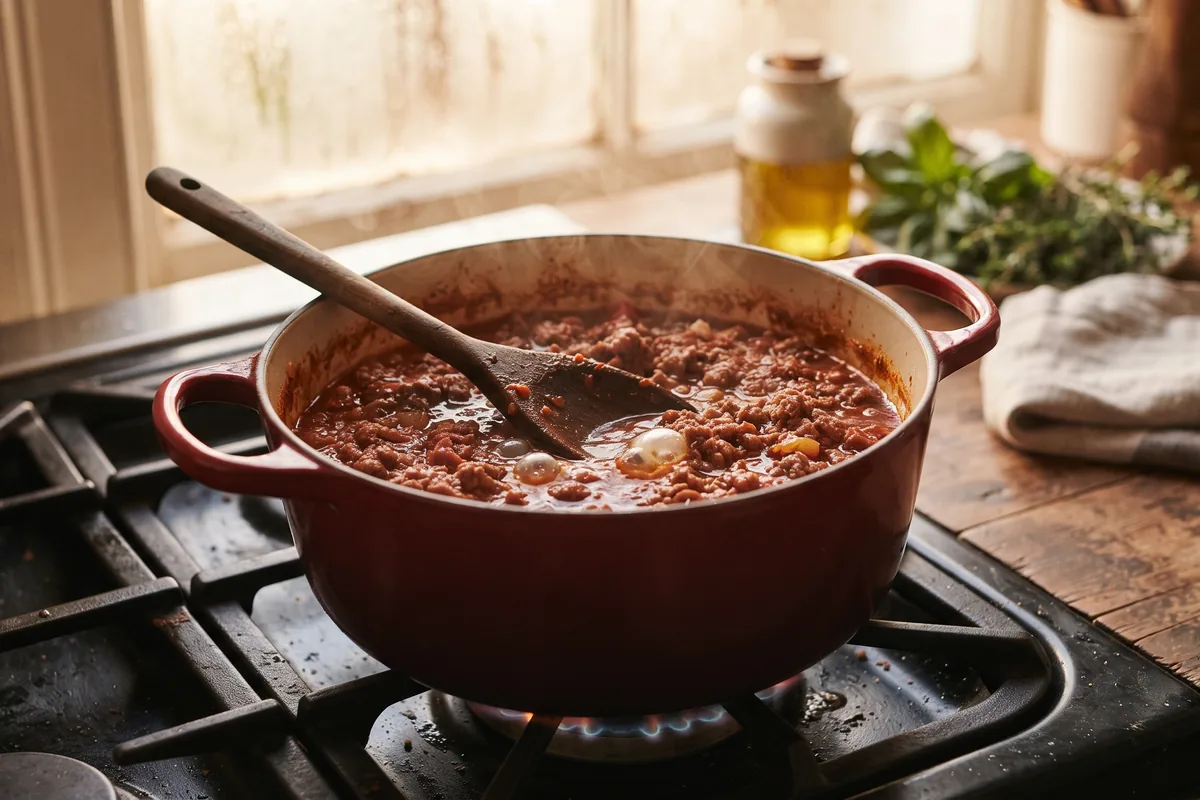
Pasta bolognese is one of the most copied dishes in the world, and one of the most misunderstood. The sauce cooked in Bologna, ragù alla bolognese, is a slow-cooked meat sauce built on finely chopped vegetables, pancetta, coarsely ground beef, a splash of wine, a little tomato and a glass of milk. It simmers gently for two to three hours until thick, glossy and deep maroon. The meat is the star; tomato plays a supporting role.
The version most Americans know, a loose red sauce with ground beef piled on spaghetti, is a different dish. This guide walks through the official recipe deposited by the Accademia Italiana della Cucina, explains why each ingredient is there, and shows how to make a pot at home that tastes like the real thing, with serving ideas, freezer notes and fixes for common mistakes.
What Pasta Bolognese Really Is
Ragù alla bolognese versus “spaghetti bolognese”
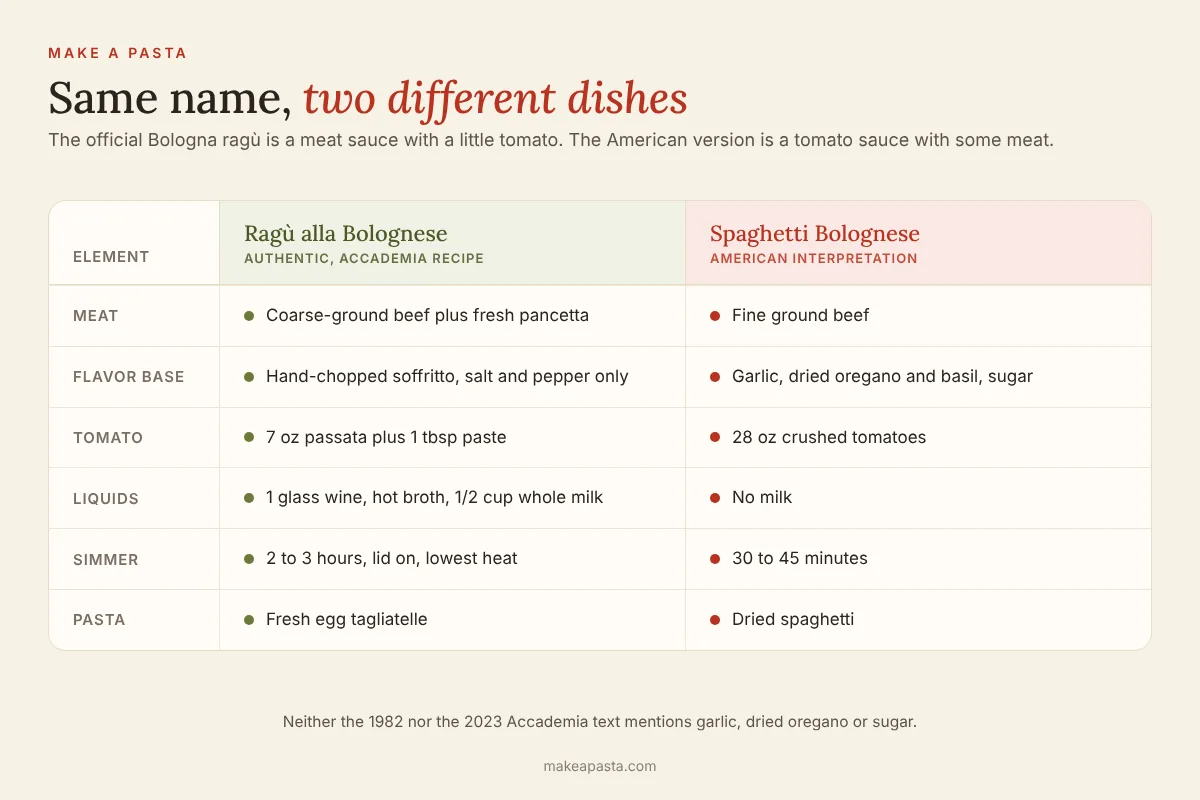
In Italian, ragù means any meat sauce cooked slowly for a long time. The words alla bolognese mark the style from Bologna, capital of Emilia-Romagna. In 1982, the city’s delegation of the Accademia Italiana della Cucina registered an official recipe with the Bologna Chamber of Commerce. The academy then updated that recipe in April 2023 to reflect how families in the city actually cook today.
Both versions share the same backbone: soffritto, pancetta, beef, wine, a modest amount of tomato, broth and milk. Neither mentions garlic, dried oregano or sugar. The American “spaghetti bolognese” flips that balance, with lots of tomato, quick browning and a 30-minute simmer, so it lands closer to a homemade spaghetti sauce with meat than to a true ragù.
Why Bologna serves it with tagliatelle, not spaghetti
In Bologna, spaghetti bolognese appears only on menus aimed at tourists. The city pairs its ragù with fresh egg tagliatelle, tortellini, lasagne or gnocchi. Fresh egg pasta is porous and wide, so a coarse meat sauce clings to every strand. Dried spaghetti is smooth and thin, and the meat slides off and sinks to the bottom of the bowl. The rule is practical, not snobbery.
Ingredients for Authentic Bolognese Sauce
The meat
The 2023 recipe calls for 400 g (about 1 lb) of coarsely ground beef for six servings. The traditional cut is cartella, the diaphragm muscle sold in the US as skirt. Brisket, chuck and blade steak are accepted, and the academy now allows a 60:40 mix of beef and pork shoulder. Ask the butcher for a coarse grind, or pulse cubes of chilled beef in a food processor. Coarse meat stays tender after three hours; fine supermarket grind can turn grainy.
Pancetta, soffritto and fat
Fresh pork pancetta (unsmoked pork belly), 150 g or about 5 oz, gives the sauce its depth and most of its fat. Cured pancetta is allowed. Smoked pancetta and American bacon are not, because smoke takes over the pot. If bacon is all you have, blanch it for two minutes first to pull out some smoke and salt.
The soffritto is about 60 g each of onion, carrot and celery, chopped by hand into small, even pieces. The academy says not to use a food processor, which bruises the vegetables and releases too much water. Extra virgin olive oil, 3 tablespoons, is the only added fat.
Milk, wine, tomato and broth
Milk is the ingredient that surprises most American cooks. One glass of whole milk, roughly 1/2 cup, goes in halfway through the simmer and reduces completely. It softens the acidity of the tomato and wine and gives the meat a rounder, more tender feel. The 1982 text even permitted a little cream for dried pasta; the 2023 update removed the cream but kept the milk as an optional step.
Wine can be red or white, one glass of about 100 ml, cooked off completely before anything else goes in. Tomato is restrained: 200 g (7 oz) of passata plus 1 tablespoon of double-concentrated paste. If you only have paste, our pasta sauce from tomato paste guide shows how to cook it out properly. Finally, light meat or vegetable broth keeps the pot moist, and a bouillon cube is officially acceptable.
| Ingredient (6 servings) | Official amount | Acceptable swap | Avoid |
|---|---|---|---|
| Beef, coarse ground | 1 lb (400 g) skirt, brisket or chuck | 60% beef, 40% pork shoulder | Extra-lean fine grind |
| Pancetta | 5 oz (150 g) fresh or cured | Blanched bacon in a pinch | Smoked pancetta |
| Onion, carrot, celery | 2 oz (60 g) each, hand chopped | Shallot for onion | Food processor paste |
| Wine | 1/2 cup (100 ml) red or white | Dry vermouth | Brandy, sweet wine |
| Tomato | 7 oz (200 g) passata + 1 tbsp paste | Crushed canned tomatoes, sieved | Flour as thickener |
| Milk | 1/2 cup (120 ml) whole | Omit if dairy free | Skim milk |
Equipment You Need
The pot and three small tools
Use a heavy casserole or Dutch oven about 10 inches (24 to 26 cm) across. Enameled cast iron, aluminum, terracotta and heavy non-stick all work. A wide base lets the meat brown rather than steam, and a thick bottom stops the sauce catching.
- A sharp chef’s knife for a fine, even soffritto.
- A flat-edged wooden spoon to break up the meat and scrape the base.
- A small saucepan to keep the broth hot, since cold liquid stalls the simmer.
Step-by-Step: How to Make Pasta Bolognese the Italian Way
- 01
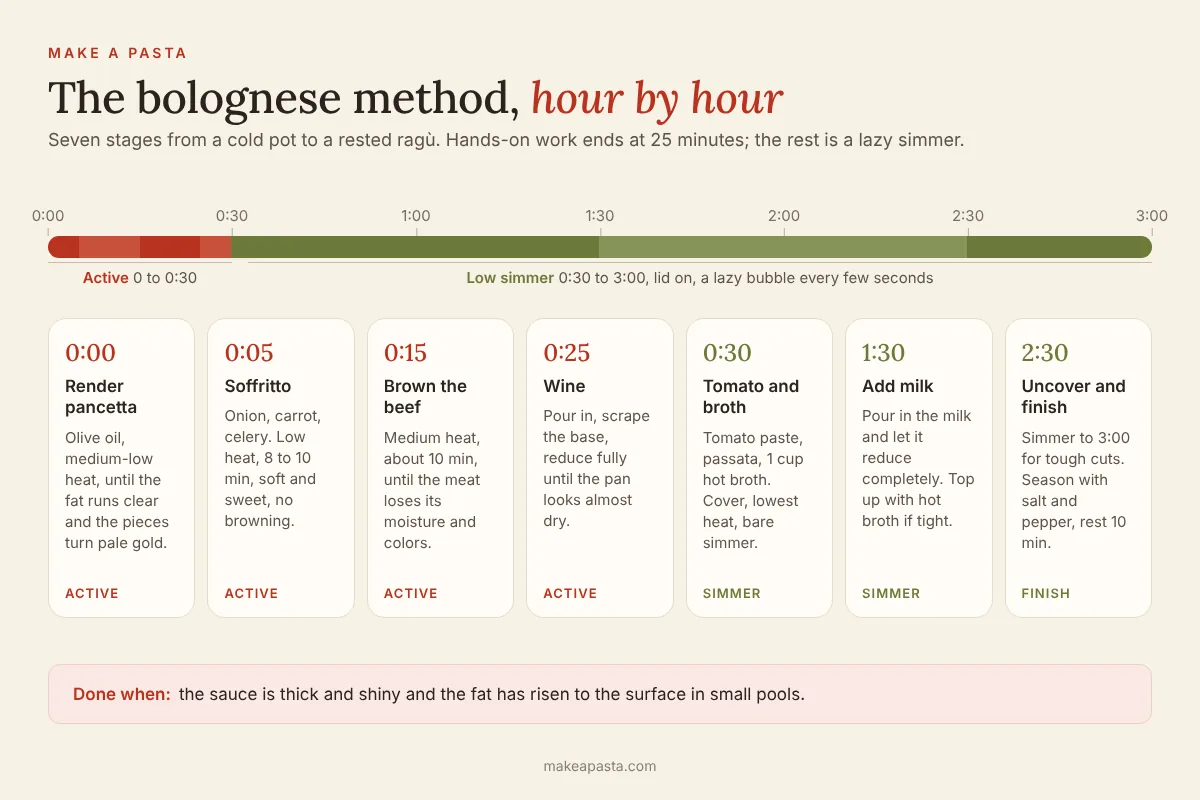
Stage 1: render the pancetta and cook the soffritto (0 to 15 minutes)
Warm the olive oil over medium-low heat and add the finely chopped pancetta. Let it melt slowly until the fat runs clear and the pieces turn pale gold. Add the onion, carrot and celery, lower the heat and cook for 8 to 10 minutes, stirring, until soft and sweet. Do not let them brown. The same patience matters in pasta carbonara, where rushed guanciale turns bitter.
- 02
Stage 2: brown the beef and reduce the wine (15 to 30 minutes)
Raise the heat to medium, add the beef and break it up with the spoon. Cook for about 10 minutes until the meat sizzles, loses its moisture and starts to color on the base of the pan. Browning builds savory depth, but avoid a hard sear that dries the meat. Pour in the wine, scrape up anything stuck, and let it bubble until the alcohol smell disappears and the pan looks almost dry.
- 03
Stage 3: tomato, broth and the long simmer (30 minutes to 3 hours)
Stir in the tomato paste and cook it for a minute, then add the passata and one cup of hot broth. Bring to a bare simmer, cover and turn the heat to its lowest setting: a lazy bubble every few seconds, never a boil. Add hot broth whenever the sauce looks tight. After about 90 minutes, pour in the milk and let it reduce completely. Simmer for 2 hours minimum, up to 3 for tougher cuts. The sauce is done when it is thick, shiny and the fat has risen to the surface in small pools.
- 04
Stage 4: finish and rest
Season with salt and black pepper only at the end, because the broth and pancetta concentrate as they reduce. Let the ragù rest off the heat for 10 minutes while you cook the pasta.
Timing, Yield and Nutrition
Timing table
| Step | Time |
|---|---|
| Prep (chopping, measuring) | 20 minutes |
| Active cooking (pancetta, soffritto, browning, wine) | 30 minutes |
| Simmer | 2 hours 30 minutes |
| Total | About 3 hours 20 minutes |
| Yield | About 4 cups sauce, 6 servings, enough for 1 lb dried or 1.3 lb fresh pasta |
Approximate nutrition per serving
These are estimates and will shift with your meat and pancetta. One serving of sauce (about 2/3 cup) lands at roughly 340 to 420 calories, 22 to 28 g protein, 24 to 30 g fat and 6 to 8 g carbohydrate. Add 3 oz of dried tagliatelle and the plate rises to about 650 to 740 calories.
How to Serve Pasta Bolognese
Choosing the pasta
- Fresh egg tagliatelle: the classic, and the best match for texture.
- Pappardelle: wider ribbons that suit an extra-rich, pork-heavy ragù.
- Lasagne alla bolognese: layers of ragù, fresh pasta and bechamel. Our bechamel white sauce guide covers a lump-free sauce.
- Gnocchi: soft homemade potato gnocchi hold the sauce in every ridge.
- Rigatoni or short tubes: a fine choice for dried pasta, since the meat gets trapped inside.
Cheese, pasta water and portioning
Finish the dish in the pan. Drain the pasta a minute early, add it to a skillet with a few ladles of ragù and a splash of starchy pasta water, then toss over medium heat for 30 seconds. The starch binds the fat into a glossy coating. Use less sauce than you think; Bologna dresses the pasta rather than drowning it. Serve with freshly grated Parmigiano-Reggiano.
Make Ahead, Freezing and Reheating
Make ahead
Ragù alla bolognese tastes better on day two. Cool it within two hours, then refrigerate in a sealed container for up to 4 days. A thin layer of fat will set on top; stir it back in when reheating.
Freezing
Portion cooled sauce into flat freezer bags in 2-cup amounts, label them and freeze for up to 3 months. Each bag covers two to three servings and thaws quickly.
Reheating
Thaw overnight in the fridge. Reheat gently in a saucepan over low heat with a spoonful of water or broth, stirring until it bubbles. The USDA recommends reheating leftovers to 165°F (74°C), and ground beef and pork should reach 160°F (71°C) during the original cook, which a three-hour simmer easily achieves.
Common Mistakes and How to Fix Them
Watery sauce
Usually the lid stayed fully on, or too much broth went in at once. Uncover and simmer for another 20 to 30 minutes. For more rescue options, see how to thicken spaghetti sauce; most of those methods work for ragù, except flour, which the academy rules out.
Greasy sauce
Some surface fat is correct, but a quarter inch of oil means the pancetta or beef was very fatty. Tilt the pot and spoon off the excess, or chill the sauce and lift the set fat away.
Grainy or dry meat
This comes from fine grind, a boil instead of a simmer, or skipping the milk. Lower the heat, add hot broth and give it another 30 minutes with the milk.
Bland sauce
Check salt first. If it still tastes flat, a teaspoon of tomato paste cooked in for five minutes, a little grated Parmigiano, or an extra 20 minutes of reduction usually fixes it. Resist adding sugar or garlic.
Variations on Bolognese Sauce
Pork-heavy ragù
Use 60% beef and 40% ground pork shoulder, the mix the academy now permits. Pork adds fat and sweetness and suits pappardelle and lasagne.
Chicken liver ragù
Older Bolognese households folded finely chopped chicken livers, hearts or gizzards in with the beef. Two or three livers per pot add deep richness without tasting of liver.
Slow cooker and pressure cooker
Complete stages 1 and 2 on the stove, since neither appliance browns well. Slow cooker: add tomato, broth and milk together and cook on low for 6 to 8 hours, lid propped for the last hour. Pressure cooker: use half a cup of broth, cook 35 minutes at high pressure, release naturally, then reduce uncovered on sauté for 10 to 15 minutes.
Vegetarian lentil and mushroom ragù
Swap the meat for 8 oz finely chopped cremini mushrooms browned hard in olive oil, plus 1 cup of cooked brown lentils. Keep the soffritto, wine, tomato and milk, and simmer for 45 minutes. It has the same texture and cling. For a lighter night, bright lemon pasta makes a good contrast to this rich sauce.
Bolognese vs Marinara vs Ragù Napoletano vs American Meat Sauce
Four red sauces compared
| Sauce | Base | Tomato level | Cook time | Typical pasta |
|---|---|---|---|---|
| Ragù alla bolognese | Ground beef, pancetta, soffritto, milk, wine | Low | 2 to 3 hours | Fresh tagliatelle, lasagne |
| Marinara | Tomatoes, garlic, olive oil, basil | Very high, no meat | 20 to 30 minutes | Spaghetti, penne |
| Ragù napoletano | Whole cuts of beef and pork braised in tomato | High | 4 to 6 hours | Ziti, paccheri |
| American meat sauce | Fine ground beef, garlic, crushed tomatoes, dried herbs | High | 30 to 60 minutes | Dried spaghetti |
When to pick each one
Bolognese rewards a free afternoon, marinara suits a Tuesday, and Neapolitan ragù is a Sunday project. Leftover bolognese spooned over cooked orzo makes an easy baked dish.
Pasta Bolognese FAQs
Can I make pasta bolognese without milk?
Yes. The 2023 official recipe lists milk as optional, so leaving it out still counts as authentic. The sauce will taste slightly sharper and the meat a little firmer. If you skip it, add an extra splash of broth near the end and let the ragù simmer a touch longer so the texture stays soft.
Red or white wine for bolognese sauce?
Either is correct according to the Accademia Italiana della Cucina. White wine gives a cleaner, lighter finish and is traditional in many Bologna households. Red adds a deeper color and a little tannin. Use a dry wine you would drink, pour in one glass, and cook it until the alcohol smell is completely gone.
Why is my bolognese not thick after two hours?
Too much liquid went in, or the lid trapped all the steam. Remove the lid, raise the heat to a steady simmer and reduce for 20 to 30 minutes while stirring. A tablespoon of tomato paste cooked in for five minutes also helps. Avoid flour or cornstarch, which dull the flavor and are not part of the recipe.
Can I use ground turkey or chicken?
You can, but the result is a different sauce. Poultry has less fat and collagen, so it dries out over a long simmer. If you use it, keep the pancetta, add the milk, and limit the simmer to about 90 minutes. A spoonful of olive oil at the end restores some of the richness that beef and pork provide.
How much sauce per person?
Plan on about 2/3 cup of ragù for 3 oz of dried pasta or 4 oz of fresh pasta per person. Italians use less sauce than Americans expect, because the pasta is tossed in the pan and lightly coated rather than topped. The six-serving recipe above yields roughly 4 cups, which also covers a 9 by 13 inch lasagne.
Is bolognese sauce the same as ragù?
No. Ragù is the general Italian word for any slow-cooked meat sauce, and Italy has dozens of regional versions. Ragù alla bolognese is the specific recipe from Bologna, with soffritto, pancetta, beef, a little tomato and milk. Neapolitan ragù, for example, uses whole pieces of meat and far more tomato.
Final Thoughts
The short version
Chop the soffritto by hand, use coarse beef and real pancetta, go easy on the tomato, cook off the wine, add the milk halfway, and give the pot at least two hours at the gentlest simmer. Serve it on fresh tagliatelle with Parmigiano-Reggiano, and your pasta bolognese will be the one the official recipe describes: thick, glossy and deep maroon.
The recipe
Ragù alla Bolognese (Authentic Pasta Bolognese)
The slow-cooked meat sauce of Bologna, based on the Accademia Italiana della Cucina official recipe: coarse beef, pancetta, soffritto, wine, a little tomato, broth and milk, simmered for 2 to 3 hours and served on fresh tagliatelle.
Ingredients
Instructions
- Warm the olive oil in a heavy 10-inch (24 to 26 cm) casserole over medium-low heat. Add the pancetta and cook slowly until the fat renders and the pieces turn pale gold, about 5 minutes.
- Add the onion, carrot and celery. Lower the heat and cook, stirring, for 8 to 10 minutes until soft and sweet but not browned.
- Raise the heat to medium. Add the beef and break it up with a wooden spoon. Cook for about 10 minutes, stirring, until the meat sizzles, releases its moisture and begins to color on the base of the pan.
- Pour in the wine, scrape up anything stuck to the pan and let it bubble until the alcohol smell is gone and the pan looks almost dry.
- Stir in the tomato paste and cook for 1 minute. Add the passata and 1 cup (240 ml) of hot broth. Bring to a bare simmer, cover and reduce the heat to the lowest setting.
- Simmer very gently for 2 hours, up to 3 hours for tougher cuts, stirring every 20 minutes and adding a splash of hot broth whenever the sauce looks tight.
- After about 90 minutes, pour in the milk and let it reduce completely into the sauce.
- When the ragù is thick, glossy and deep maroon with small pools of fat on the surface, season with salt and pepper. Rest off the heat for 10 minutes.
- Cook the tagliatelle in well-salted water until just shy of al dente. Transfer to a skillet with a few ladles of ragù and a splash of pasta water, toss over medium heat for 30 seconds and serve with Parmigiano-Reggiano.
Notes
Chop the soffritto by hand; a food processor releases too much water and bruises the vegetables. Ask for a coarse grind or pulse chilled beef cubes in a food processor. Fine grind turns grainy over a long simmer. Smoked pancetta and bacon are not traditional. If using bacon, blanch it for 2 minutes first. Milk is optional in the 2023 official recipe but gives a softer, rounder sauce. The sauce keeps 4 days refrigerated or 3 months frozen. Reheat gently to 165°F (74°C). A 60:40 mix of beef and pork shoulder is permitted and makes a richer sauce.