In this recipe
- What Makes Pasta Carbonara Authentic
- Pasta Carbonara Ingredients
- Guanciale vs Pancetta vs Bacon
- Why There Is No Cream in Carbonara
- Spaghetti or Rigatoni?
- How to Make Pasta Carbonara
- 3 Ways to Keep the Eggs From Scrambling
- Egg Safety: An Honest Note
- Carbonara Troubleshooting
- Variations
- Storage and Reheating
- Pasta Carbonara Nutrition
- Pasta Carbonara FAQs
- Printable Recipe Card
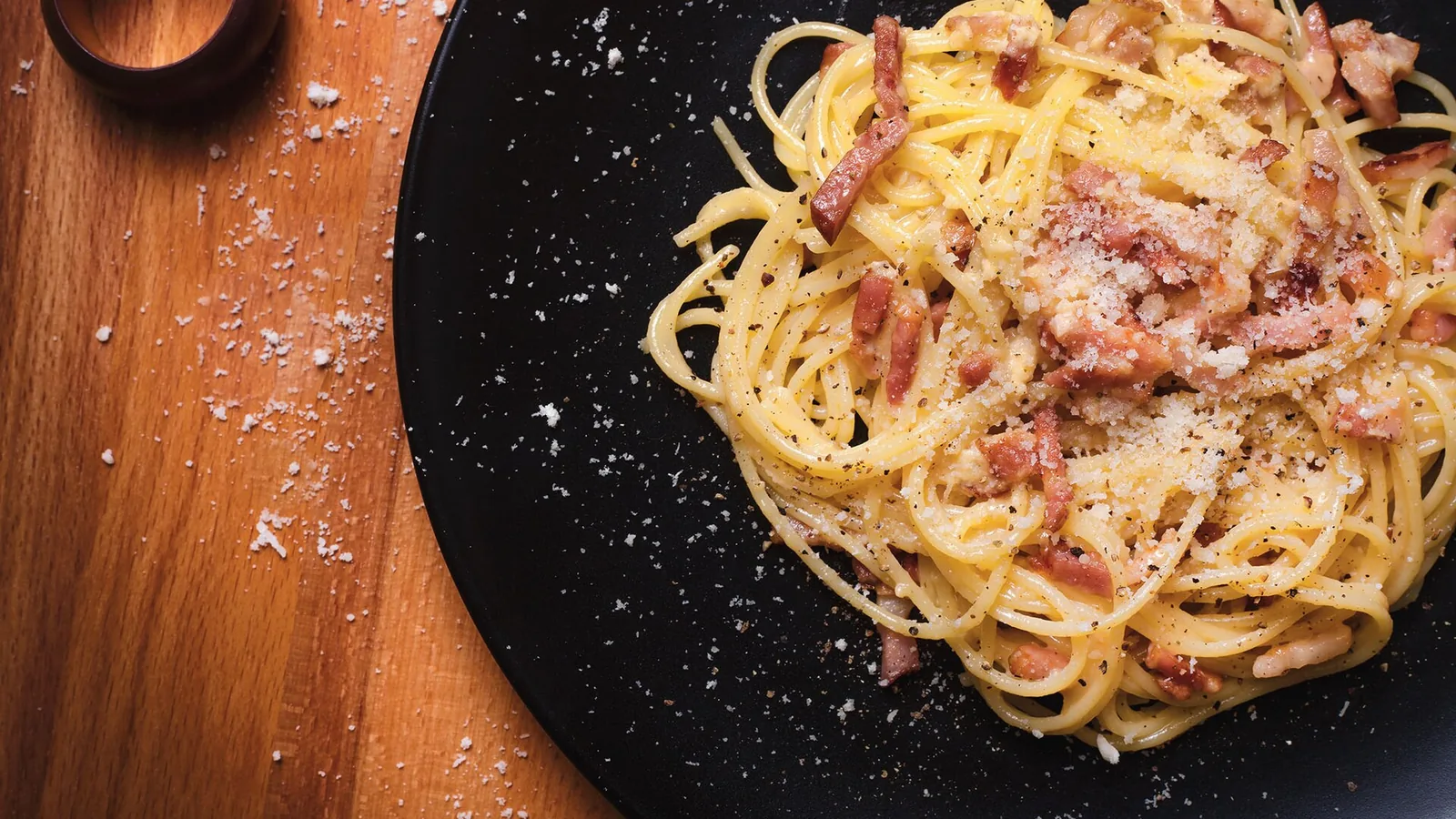
Pasta carbonara is a Roman dish made from just five things: guanciale, eggs, Pecorino Romano, black pepper and pasta. There is no cream, no garlic and no butter. The sauce gets its silky texture from egg yolks, finely grated cheese, rendered pork fat and a little starchy pasta water.
The hard part is the eggs. Add them to a pan that is too hot and they set into small curds. Add them too cool and the sauce stays thin. This recipe serves 4 in about 25 minutes, and it shows three ways to land in between: off the heat, tempering with pasta water and a gentle bain-marie.
Below: what each ingredient does, the best swaps for guanciale, why cream does not belong, a step-by-step method, an honest egg safety note, fixes for common problems, variations, storage and approximate nutrition.
What Makes Pasta Carbonara Authentic
Carbonara belongs to a family of Roman pastas that share the same base. Pasta alla gricia is guanciale, Pecorino and pepper. Cacio e pepe is just Pecorino and pepper. Carbonara adds eggs, which turn the cheese and fat into a rich, golden sauce. Its exact origin is debated, but the Roman version is clear about the ingredients.
- Guanciale. Cured pork cheek, not bacon. It renders a clean, sweet fat that carries the sauce.
- Pecorino Romano. A hard, salty sheep’s milk cheese. It gives carbonara its sharp, tangy edge.
- Eggs. Yolks for richness, sometimes with a few whole eggs for volume.
- Black pepper. Coarsely ground and generous. It is a main flavor here, not a garnish.
- Pasta. Spaghetti is the classic. Rigatoni is a popular Roman alternative.
Everything else is a variation. Peas, mushrooms, garlic, onion and cream all show up in restaurant versions outside Italy. They can taste good, but they are not part of the Roman method.
Pasta Carbonara Ingredients
With so few ingredients, each one matters. Here is what to buy for 4 servings and why.
- Pasta: 1 pound (454 g). Dried spaghetti or rigatoni. Bronze-cut pasta has a rougher surface that helps the sauce cling.
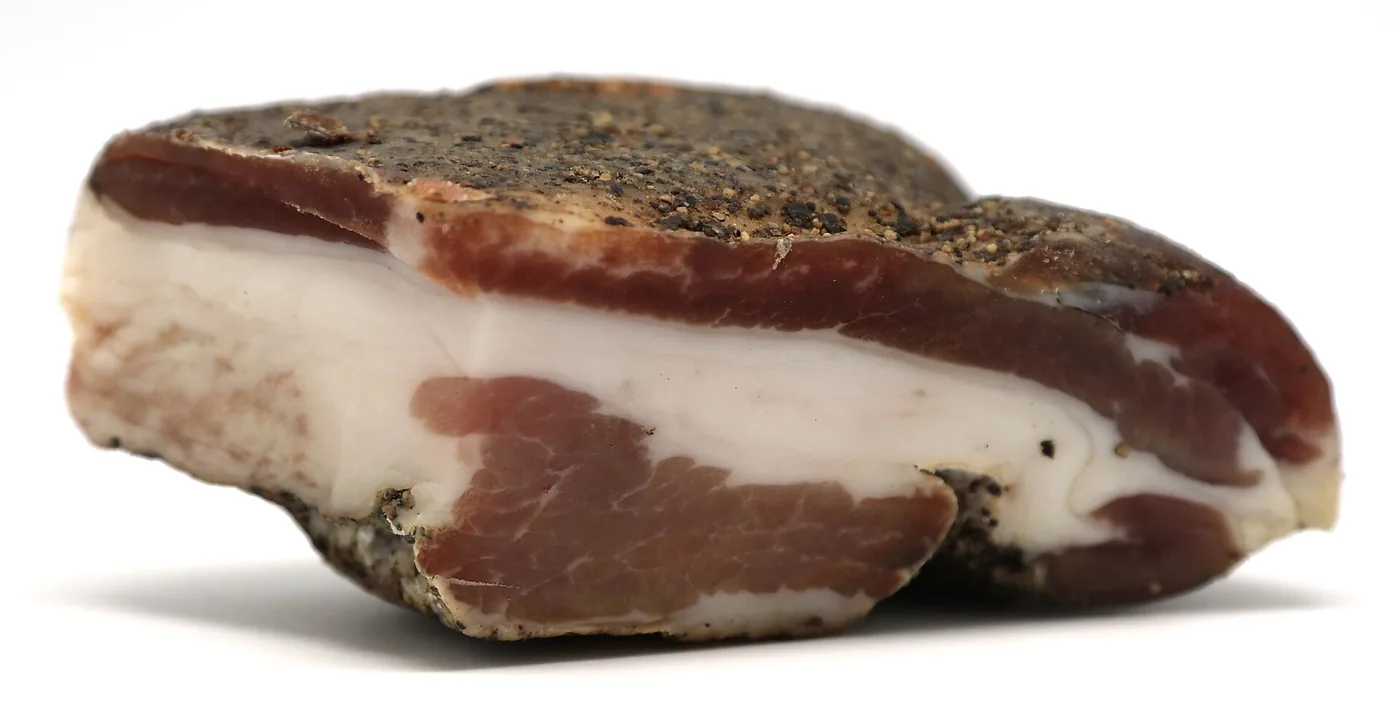
- Guanciale: 6 ounces (170 g). Cut off the tough outer rind, then slice it into strips about 1/4 inch thick. Thicker pieces stay chewy inside while the edges crisp.
- Eggs: 2 large eggs plus 4 large yolks. Yolks make the sauce rich and golden. The whole eggs add volume so it coats a full pound of pasta. Save the whites for an omelet.
- Pecorino Romano: 2 ounces (56 g), finely grated. Grate it on a fine rasp so it melts on contact. Coarse shreds clump.
- Black pepper: 2 teaspoons, coarsely ground. Grind it fresh. Toasting some of it in the guanciale fat brings out its aroma.
- Pasta water: about 1 1/2 cups, reserved. The starch in it binds the fat, eggs and cheese into one smooth sauce.

Salt the pasta water lightly. Guanciale and Pecorino Romano both bring plenty of salt, and the reserved pasta water goes into the sauce. Taste before adding any more.
Guanciale vs Pancetta vs Bacon
Guanciale can be hard to find in regular US supermarkets. Italian delis and specialty butchers often carry it. If you cannot get it, pancetta and bacon both work, as long as you know what changes.
| Option | Cut and cure | Flavor in carbonara | How to use it |
|---|---|---|---|
| Guanciale | Pork cheek or jowl, cured, not smoked | Rich, sweet fat; the classic flavor | Remove the rind, cut into 1/4-inch strips |
| Pancetta | Pork belly, cured, usually not smoked | Leaner and milder; the closest swap | Buy it in one piece and dice it, if you can |
| Thick-cut bacon | Pork belly, cured and smoked | Smoky; a different but tasty dish | Choose unsweetened bacon and cut it into strips |
| Turkey bacon | Turkey, cured, often smoked | Lean, with little fat to build the sauce | Add 1 to 2 tablespoons of olive oil to the pan |
Whatever you use, render it slowly. Start it in a cold pan over medium heat so the fat melts out before the meat browns. You want crisp edges and a slightly chewy center, plus a few tablespoons of clear fat for the sauce.
Why There Is No Cream in Carbonara
Cream is the most common addition to carbonara outside Italy, and the most debated. The Roman method leaves it out for three practical reasons.
- The eggs already make it creamy. Yolks, cheese, fat and starchy water form an emulsion. That is a smooth sauce in which fat stays suspended in liquid. It looks creamy without any dairy beyond the cheese.
- Cream mutes the flavor. Guanciale, Pecorino and pepper are bold. Cream softens all three and makes the dish taste heavier.
- Cream hides mistakes. Many recipes add it as insurance against scrambling. The methods below solve that problem without changing the dish.
If you love a cream sauce, make a dish built for it. Our fettuccine Alfredo and creamy pasta sauce use cream on purpose. For a no-cream sauce with a similar glossy finish, see our garlic butter pasta, which relies on the same pasta water trick.
Spaghetti or Rigatoni?
Spaghetti is the shape most people picture. Rigatoni is just as common in Rome. Both work, but they eat differently.
| Shape | How it works here | Best for |
|---|---|---|
| Spaghetti | Thin strands coat evenly and twirl well | The classic version |
| Rigatoni | Wide tubes trap sauce and guanciale inside | A heartier, chunkier bowl |
| Tonnarelli | Square-cut fresh strands with a chewy bite | A trattoria-style version |
| Bucatini | Thick, hollow strands | Extra chew |
| Mezze maniche | Short, wide tubes | Kids and easy forking |
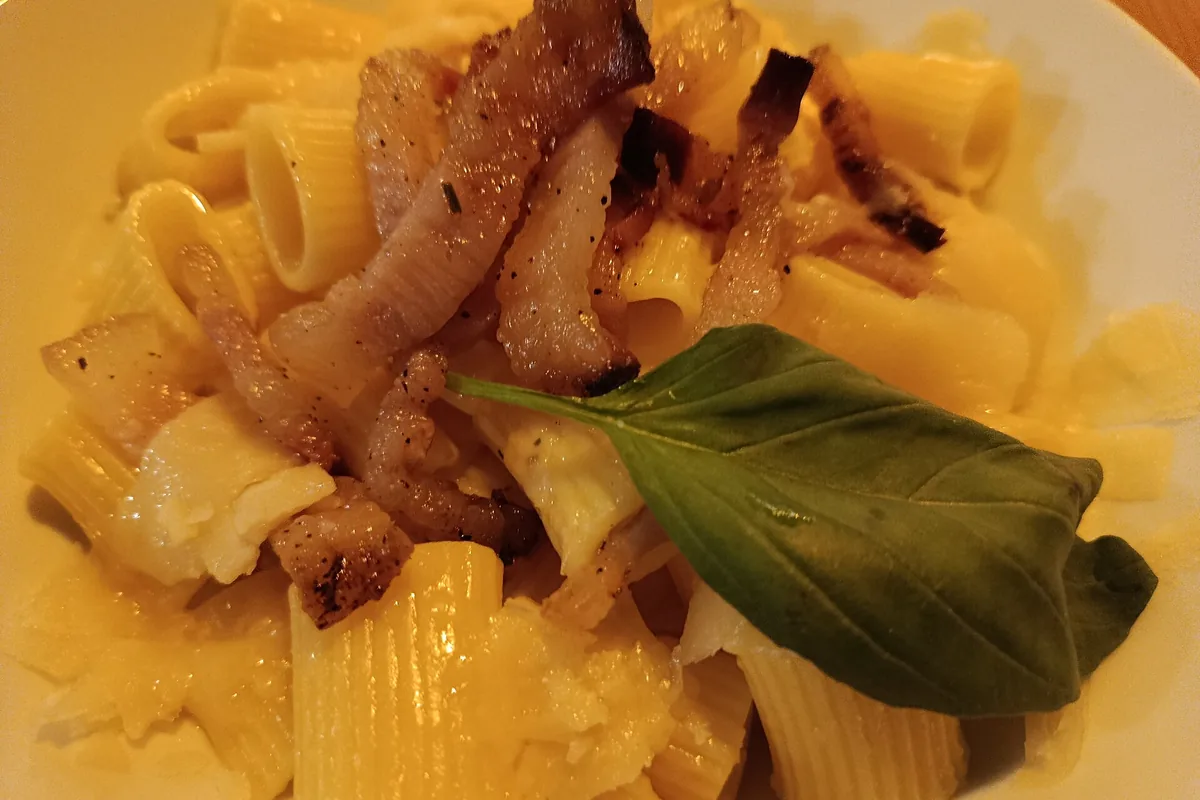
Rigatoni takes longer to cook, often 11 to 13 minutes. Check the package and start the guanciale so it finishes a few minutes before the pasta.
How to Make Pasta Carbonara
The total is about 25 minutes. Prep while the water heats, render the guanciale while the pasta cooks, then build the sauce in the last 2 minutes. Read the steps once before you start, because the end moves quickly.
- 01
Put the water on
Bring 4 quarts of water to a boil in a large pot. Salt it lightly, with about 2 teaspoons of kosher salt. The guanciale and cheese will add the rest.
- 02
Prep the guanciale and cheese
Trim the rind from the guanciale and cut it into strips about 1/4 inch thick. Grate the Pecorino finely and grind the pepper coarsely.
- 03
Make the egg mixture
In a large heatproof bowl, whisk 2 eggs, 4 yolks, the Pecorino and 1 1/2 teaspoons of the pepper. It should form a thick, sticky paste. Leave it on the counter so it is not fridge-cold.
- 04
Render the guanciale
Put the guanciale in a cold large skillet and set it over medium heat. Cook for 8 to 10 minutes, stirring now and then, until the fat turns clear and the edges are crisp and golden. Add the rest of the pepper for the last 30 seconds, then turn off the heat.
- 05
Cook the pasta
Add the pasta to the boiling water and stir for the first 30 seconds. Cook until 1 minute short of the package time. Before draining, scoop out 1 1/2 cups of the cloudy pasta water.
- 06
Temper the eggs
Whisk 2 to 3 tablespoons of the hot pasta water into the egg mixture, one spoonful at a time. The paste loosens into a warm, pourable cream.
- 07
Toss the pasta in the fat, off the heat
Add the drained pasta to the skillet with the guanciale and fat. The burner stays off. Toss to coat, add a splash of pasta water and wait until the pan stops sizzling, about 1 minute.
- 08
Add the eggs and toss
Pour the egg mixture over the pasta. Toss constantly with tongs for 1 to 2 minutes, adding pasta water a tablespoon at a time. Stop when the sauce is glossy and flows like heavy cream.
- 09
Serve right away
Divide among warm bowls and finish with more Pecorino and black pepper. The sauce keeps thickening as it sits, so do not let it wait.

Finished carbonara should be glossy and golden, with no visible curds of egg. Photo: Lasagnolo9 at Italian Wikipedia, CC BY-SA 4.0, via Wikimedia Commons (cropped)
The pan should be warm, not hot. If you hear a sizzle when the eggs go in, it is too hot. If the sauce is still thin after 2 minutes of tossing, switch to the bain-marie method below.
| Time | Pot | Skillet and bowl |
|---|---|---|
| 0 to 10 min | Water heats to a boil | Prep guanciale, grate cheese, whisk the egg mixture |
| 10 to 20 min | Pasta cooks | Guanciale renders for 8 to 10 minutes; burner off |
| 20 to 22 min | Drain; save 1 1/2 cups water | Temper the eggs; toss pasta in the fat |
| 22 to 25 min | Keep at a bare simmer for a bain-marie | Add eggs, toss, loosen with water, serve |
3 Ways to Keep the Eggs From Scrambling
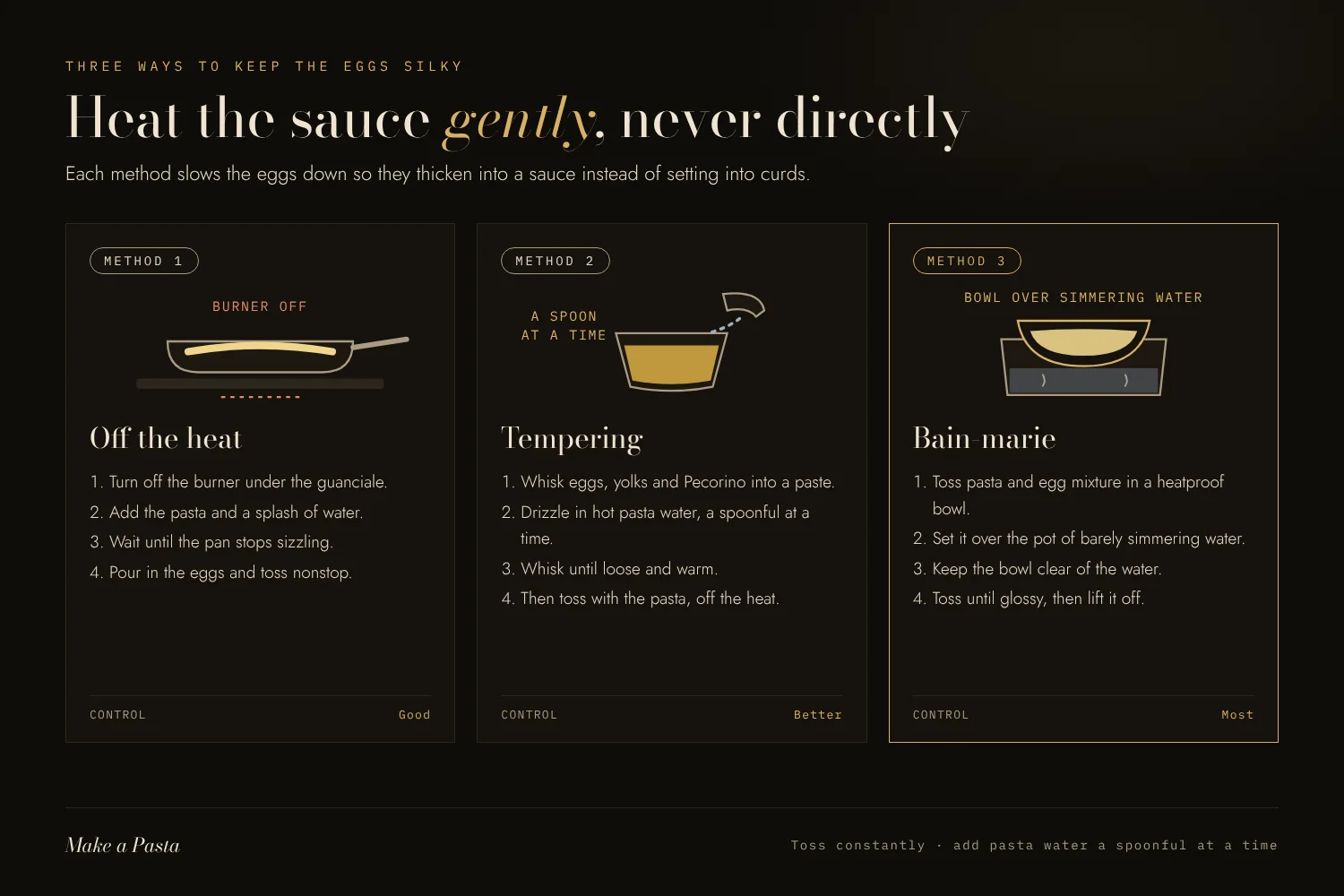
Eggs thicken as they warm and set into curds if they get too hot. A good carbonara stops right before that point. All three methods below slow the heat down. You can use one or combine them.
1. Off the Heat
This is the classic Roman approach. The burner goes off before the pasta joins the guanciale. A splash of pasta water cools the pan further. The heat stored in the pasta and skillet is enough to thicken the eggs while you toss. It is fast, but it depends on judging the pan’s temperature. A heavy cast-iron skillet holds heat longer than a thin pan, so give it extra time to cool.
2. Tempering With Pasta Water
Tempering means warming the eggs gradually before they meet the hot pasta. Whisk a few spoonfuls of hot pasta water into the egg mixture, one at a time. This raises its temperature slowly and thins it out. Warm, loose eggs spread evenly over the pasta instead of setting where they touch hot metal. Tempering pairs well with the off-the-heat method, and the recipe card uses both.
3. The Bain-Marie Method
A bain-marie is a bowl set over gently simmering water. It gives you the most control. Toss the drained pasta, guanciale and fat with the egg mixture in a large heatproof bowl, metal or glass. Set the bowl over the pasta pot with the water at a bare simmer, so the bowl does not touch the water. Toss constantly. Lift the bowl off as soon as the sauce turns glossy and coats the pasta, then put it back if it needs more time.
- Toss, do not stir. Lifting the pasta with tongs keeps the eggs moving so no part overheats.
- Keep pasta water close. A tablespoon at a time loosens the sauce and slows the cooking.
- Use a big bowl. Room to toss matters more than the shape of the pan.
Egg Safety: An Honest Note
Carbonara is made with eggs that are warmed by the pasta, not fully cooked. That matters for food safety. According to the USDA’s guide to shell eggs, fresh eggs may contain Salmonella bacteria. USDA advises cooking dishes that contain eggs to 160°F, checked with a food thermometer.
To be clear, a traditional carbonara may not reach 160°F. The sauce is meant to stay just below the point where eggs set firm, and the Roman method does not use a thermometer. Some cooks use the bain-marie method to bring the sauce up to 160°F, measured with an instant-read thermometer. That can be done, but the sauce turns thicker, and the window before it curdles is narrow.
The simplest way to lower the risk is to use pasteurized eggs. USDA recommends pasteurized eggs or egg products for recipes that call for raw or undercooked eggs. Pasteurized shell eggs are sold in many US grocery stores, usually marked on the carton. They behave almost the same in carbonara.
- Use pasteurized eggs if you are serving anyone pregnant, a young child, an older adult or someone with a weakened immune system. USDA names these groups as more vulnerable to Salmonella.
- Keep eggs refrigerated until you start cooking, and do not use cracked or dirty eggs.
- Serve it right away. Do not leave carbonara at room temperature for more than 2 hours.
Carbonara Troubleshooting
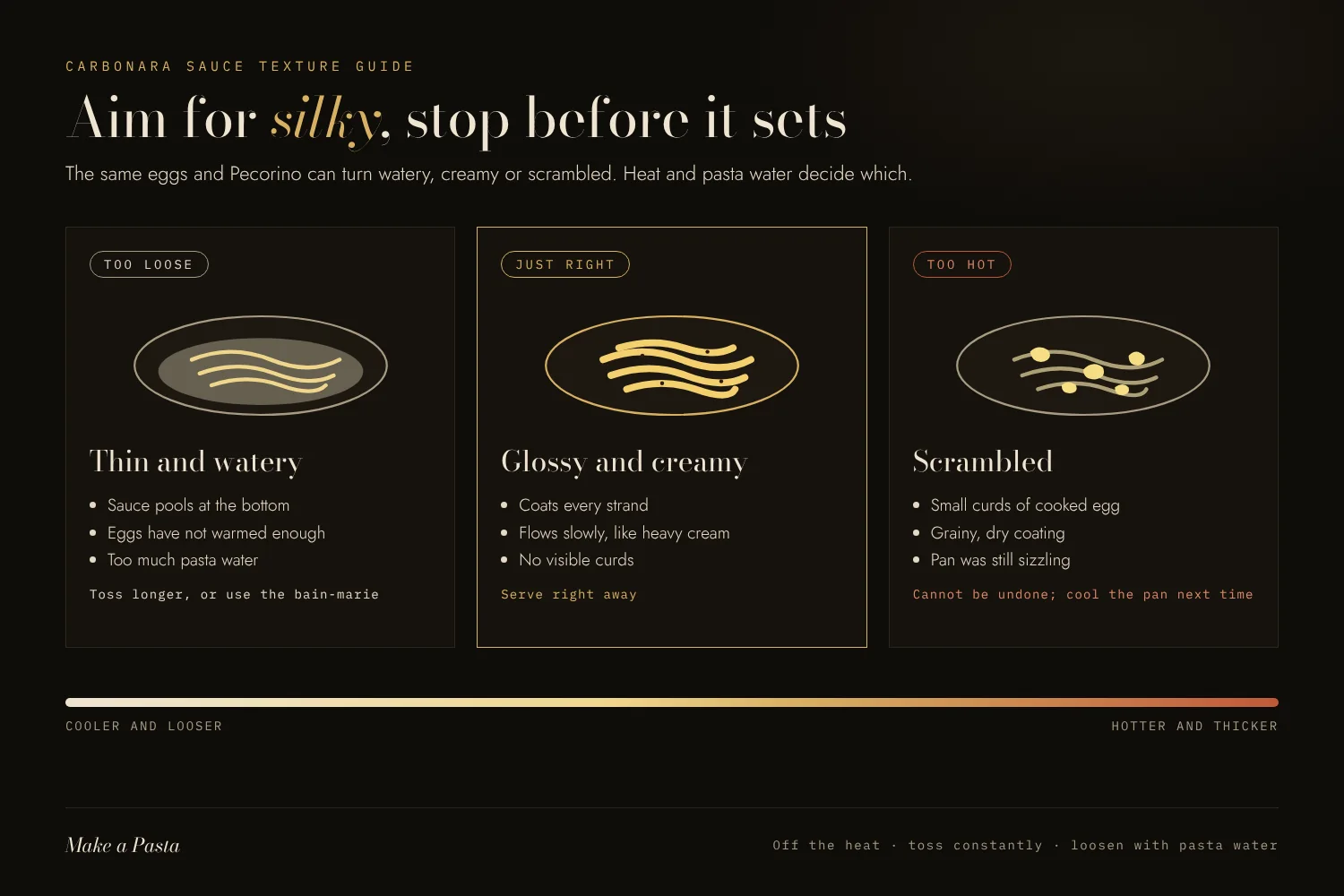
Most carbonara problems come down to heat, water or cheese. This table covers the common ones.
| Problem | Likely cause | Fix |
|---|---|---|
| Scrambled, curdled eggs | The pan was still hot when the eggs went in | Burner off, add water, wait for the sizzle to stop |
| Thin, watery sauce | Eggs too cold, or too much water at once | Toss longer, or use the bain-marie for 30 to 60 seconds |
| Clumpy cheese | Coarse cheese, or cheese added to a hot pan | Grate it finely and mix it into the eggs first |
| Too salty | Salty pasta water plus guanciale and Pecorino | Salt the water lightly and taste before seasoning |
| Greasy sauce | Too much fat and too little pasta water | Pour off some fat, or toss in more pasta water |
| Dry, sticky pasta | The sauce kept thickening as it sat | Loosen with a splash of pasta water and serve at once |
| Chewy, rubbery guanciale | Cooked too fast over high heat | Start it in a cold pan over medium heat |
Clumping cheese is a heat problem as much as a cheese problem. Our guide to cheese sauce for pasta explains why cheese turns grainy and how gentle heat prevents it.
Variations
The Roman recipe is the base. These versions change one thing at a time.
Pancetta or Bacon Carbonara
Swap the guanciale for the same weight of pancetta or thick-cut bacon. Lean pancetta renders less fat, so keep an extra splash of pasta water ready. Bacon adds smoke, which some people prefer.
Half Pecorino, Half Parmesan
Use 1 ounce of each cheese. Parmigiano Reggiano is milder and nuttier, so the sauce tastes rounder and less salty. It is a good choice for anyone who finds Pecorino too sharp.
All-Yolk Carbonara
Use 6 to 8 yolks and no whole eggs. The sauce turns deeper gold, thicker and richer. Save the whites for an omelet or meringues.
Pasta alla Gricia
Leave out the eggs entirely. Toss the pasta with guanciale, its fat, Pecorino, pepper and pasta water until creamy. It is carbonara’s simpler Roman cousin.
Vegetarian Carbonara
Replace the guanciale with sliced mushrooms or zucchini, browned in 3 tablespoons of olive oil. Pecorino Romano is traditionally made with animal rennet, so check the label if you need a vegetarian cheese.
Looking for a different weeknight pasta? Our vodka pasta and white sauce pasta are both creamy and kid-friendly. Browse more ideas in our pasta recipes.
Storage and Reheating
Carbonara is best eaten the moment it is made. The egg sauce thickens and firms as it cools, and it never quite returns to its first silky state. Leftovers are still safe and tasty with a little care.
- Refrigerate within 2 hours. Use a shallow airtight container so the pasta cools quickly.
- Eat within 3 to 4 days. This matches USDA guidance for cooked egg dishes kept in the fridge.
- Reheat gently. Warm it in a skillet over low heat with 1 to 2 tablespoons of water per serving, tossing often. Heat it until hot all the way through, to 165°F (74°C).
- Microwave in short bursts. Cover the bowl loosely, heat for 30 seconds at a time and stir between each.
- Skip the freezer. Frozen and thawed carbonara turns grainy and dry.
Reheating will set the eggs further, so expect a firmer sauce. To get ahead instead, cut the guanciale, grate the cheese and whisk the egg mixture earlier in the day. Keep the egg mixture covered in the fridge and take it out 20 minutes before cooking.
Pasta Carbonara Nutrition
These figures are approximate. They were calculated from ingredient values in the USDA’s FoodData Central database, based on 4 servings. Raw pork jowl stands in for guanciale, and the estimate assumes all the rendered fat goes into the sauce. Sodium is not listed because it depends on the cured pork, the cheese and the salt in the pasta water.
| Nutrient | Amount | Main sources |
|---|---|---|
| Calories | About 850 | Pasta and guanciale fat |
| Protein | About 28 g | Pasta, eggs and Pecorino |
| Carbohydrate | About 87 g | Pasta |
| Fat | About 42 g | Guanciale, yolks and Pecorino |
| Saturated fat | About 16 g | Guanciale and Pecorino |
| Fiber | About 4 g | Pasta |
Carbonara is rich. For a lighter plate, pour off some of the rendered fat, use 4 ounces of guanciale, or serve smaller portions with a green salad. Values change with your brand of pasta, your cut of pork and your portion size.
Pasta Carbonara FAQs
Does authentic carbonara have cream?
No. Roman carbonara is made with guanciale, eggs, Pecorino Romano, black pepper and pasta. The creamy texture comes from egg yolks, cheese, rendered fat and starchy pasta water, not from cream.
How do you keep carbonara eggs from scrambling?
Take the pan off the heat before the eggs go in, temper the egg mixture with a few spoonfuls of hot pasta water, and toss constantly. For the most control, finish the pasta in a heatproof bowl set over a pot of barely simmering water.
Can I use bacon instead of guanciale?
Yes. Thick-cut bacon works, but it is smoked, so the dish tastes smokier and less porky. Pancetta is the closer swap because it is cured but usually not smoked.
Is it safe to eat carbonara with raw eggs?
The eggs in carbonara are warmed by the hot pasta, but the sauce may not reach 160°F, the temperature USDA recommends for egg dishes. For pregnant people, young children, older adults or anyone with a weakened immune system, use pasteurized eggs.
Can I use Parmesan instead of Pecorino Romano?
Yes. Parmigiano Reggiano gives a milder, nuttier sauce. Many cooks use half Pecorino and half Parmesan. Pecorino Romano gives the sharper, saltier flavor of the Roman original.
Should I use whole eggs or just yolks for carbonara?
Both work. Yolks make a richer, more golden sauce, while whole eggs make it lighter but more prone to scrambling. This recipe uses 2 whole eggs and 4 yolks for a balance of richness and volume.
Why is my carbonara sauce watery?
The eggs did not get warm enough to thicken, or too much pasta water went in at once. Keep tossing for another minute, or set the bowl over simmering water and toss until it turns glossy.
Can you reheat leftover carbonara?
You can, but the texture changes. Reheat it gently in a skillet over low heat with a splash of water until it is hot all the way through, to 165°F (74°C). Expect a firmer, less silky sauce.
The recipe
Authentic Pasta Carbonara
Roman-style carbonara with crisp guanciale, Pecorino Romano, eggs, yolks and black pepper, tossed off the heat with starchy pasta water into a glossy, no-cream sauce. Serves 4.
Ingredients
Instructions
- Boil the water. Bring 4 quarts of water to a boil in a large pot. Salt it lightly, with about 2 teaspoons of kosher salt, because the guanciale and Pecorino are already salty.
- Make the egg mixture. In a large heatproof bowl, whisk the eggs, egg yolks, Pecorino Romano and 1 1/2 teaspoons of the pepper into a thick paste. Leave it at room temperature while you cook.
- Render the guanciale. Put the guanciale in a cold large skillet and set it over medium heat. Cook for 8 to 10 minutes, stirring now and then, until the fat turns clear and the edges are crisp and golden. Add the remaining pepper for the last 30 seconds, then turn off the heat.
- Cook the pasta. Cook the pasta until 1 minute short of the package time. Before draining, scoop out 1 1/2 cups of the starchy pasta water.
- Temper the eggs. Whisk 2 to 3 tablespoons of the hot pasta water into the egg mixture, one spoonful at a time, until it loosens into a pourable cream.
- Toss off the heat. Add the drained pasta to the skillet with the guanciale and its fat, off the heat, and toss to coat. Add a splash of pasta water and wait until the pan stops sizzling, about 1 minute.
- Add the eggs. Pour the egg mixture over the pasta and toss constantly for 1 to 2 minutes. Add pasta water a tablespoon at a time until the sauce turns glossy and creamy. If it stays thin, use the bain-marie method in the notes.
- Serve right away. Divide among warm bowls and top with more Pecorino and black pepper. Carbonara thickens as it sits, so serve it immediately.
Notes
Bain-marie method: if the sauce stays thin, toss the pasta and egg mixture in a heatproof bowl set over the pot of barely simmering water until glossy, then lift it off. Egg safety: the sauce may not reach 160°F, the USDA recommendation for egg dishes; use pasteurized eggs for anyone pregnant, very young, older or with a weakened immune system. Leftovers keep for 3 to 4 days in the fridge; reheat gently to 165°F (74°C). Approximate nutrition per serving, calculated from USDA ingredient data: about 850 calories, 28 g protein, 87 g carbohydrate and 42 g fat.