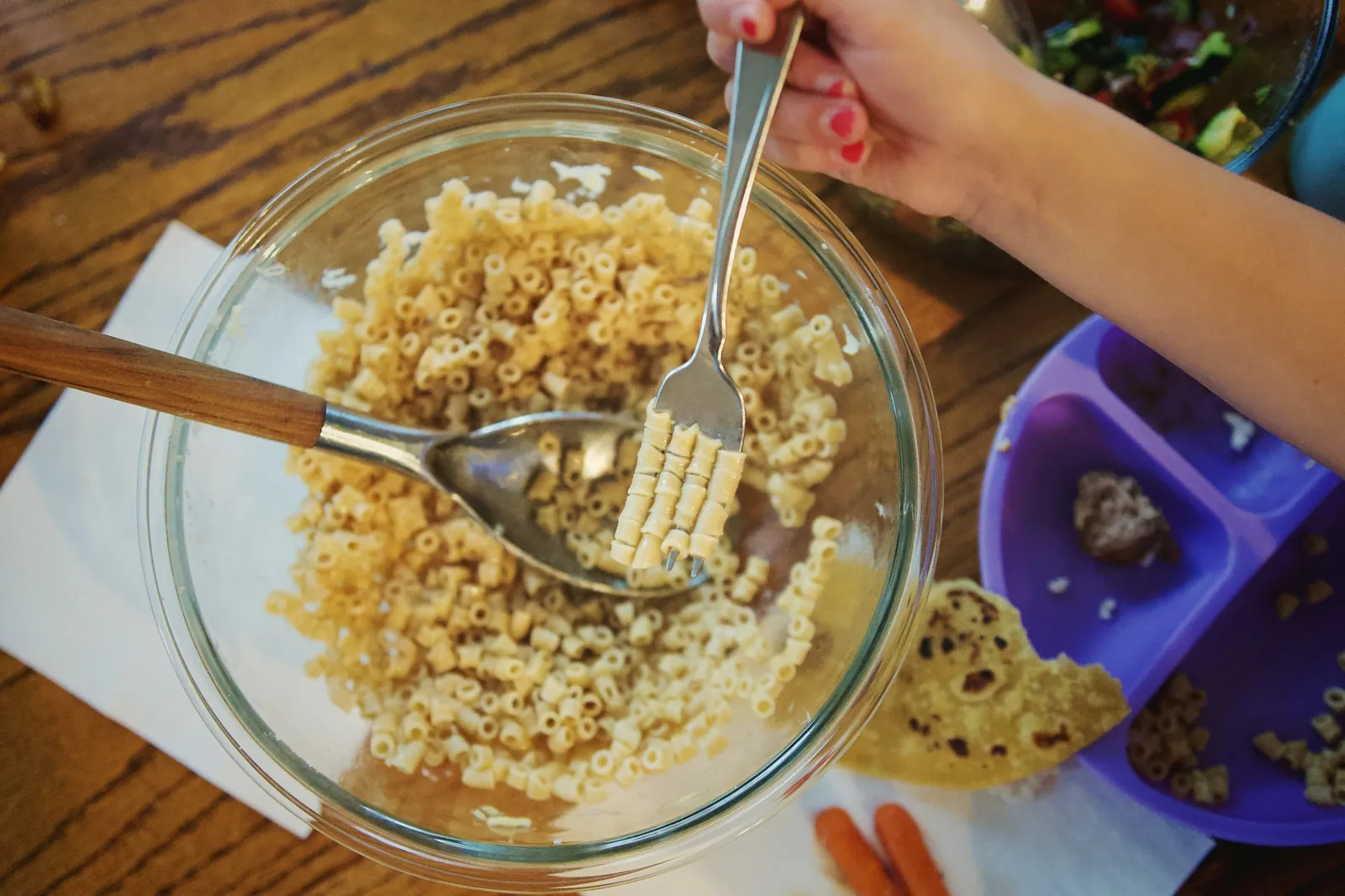
In this guide
- Can You Cook Pasta in the Microwave?
- What You Need: Bowl, Water and Salt
- How to Cook Pasta in the Microwave
- Microwave Pasta Times by Shape
- Adjusting Times for Microwave Wattage
- Water Ratio Chart for 1, 2 or 4 Servings
- How to Stop Pasta Boiling Over
- Mug Pasta and Microwave Mac and Cheese
- Microwave Pasta Safety
- Reheating Cooked Pasta in the Microwave
- Troubleshooting: Gummy, Crunchy or Foamy Pasta
- Microwave Pasta FAQs
- Printable Recipe Card
To cook pasta in the microwave, put dried pasta in a large microwave-safe bowl, cover it with cold water by about 2 inches, add a pinch of salt and microwave on high for the package cooking time plus about 3 minutes. Stir halfway through, taste a piece near the end, then drain. One or two servings take roughly 12 to 16 minutes in a 1,000-watt microwave.
The extra minutes cover the time the water needs to come to a boil, which happens inside the oven instead of on a burner. Everything else follows the same logic as a pot on the stove: plenty of water, a stir to stop sticking and a taste test before you drain.
Below: the step-by-step method, a times chart for seven shapes, adjustments for 700, 1,000 and 1,200-watt microwaves, a water chart by portion, boil-over fixes, mug pasta, mac and cheese, safety, reheating and fixes for gummy or crunchy results.
Can You Cook Pasta in the Microwave?
Yes. Dried pasta only needs hot water and time to soften, and a microwave heats water perfectly well. The texture is close to stovetop pasta when you use enough water and pull it at the right moment. A microwave heats unevenly, though, so stirring and tasting matter more.
The method earns its place in a few situations. It suits a dorm room, an office kitchen or a hotel room with no stove. It works for a single portion when boiling a big pot feels like a waste. It also keeps the kitchen cooler in summer.
It is not the best choice for a crowd. Every extra cup of water adds minutes, so for four or more servings a pot on the stove is usually faster.
What You Need: Bowl, Water and Salt

A large microwave-safe bowl is the most important piece of equipment. Choose glass or ceramic marked microwave-safe, big enough that the water fills no more than about half of it. Starchy water foams as it boils, and that foam needs room to rise. For one serving, a 2-quart (2 L) bowl works. For two, use one that holds at least 2 1/2 to 3 quarts (2.4 to 2.8 L).
For spaghetti, linguine or fettuccine, a rectangular glass baking dish lets the strands lie flat under the water. If you only have a round bowl, break long pasta in half so every piece stays submerged.
Use cold tap water, enough to cover the pasta by 1 to 2 inches (2.5 to 5 cm). Dried pasta roughly doubles in size as it absorbs water, so a shallow cover runs dry before the pasta is cooked. Two inches is the safer target.
Add about 1/2 teaspoon of kosher salt for each 2 cups of water. Salt in the water is the only chance to season the pasta itself. You will also want a large plate under the bowl, oven mitts or a thick towel, a colander and a fork for tasting.
How to Cook Pasta in the Microwave
Check the package for the stovetop cooking time before you start. That number is your anchor: you will microwave for that time plus about 3 minutes, and start tasting a couple of minutes before the end.
- 01
Add pasta, water and salt
Put the dried pasta in the bowl, breaking long shapes in half if needed. Pour in cold water until it sits 1 to 2 inches above the pasta, add the salt and stir once. Stirring now separates pieces that would otherwise fuse together as the water heats.
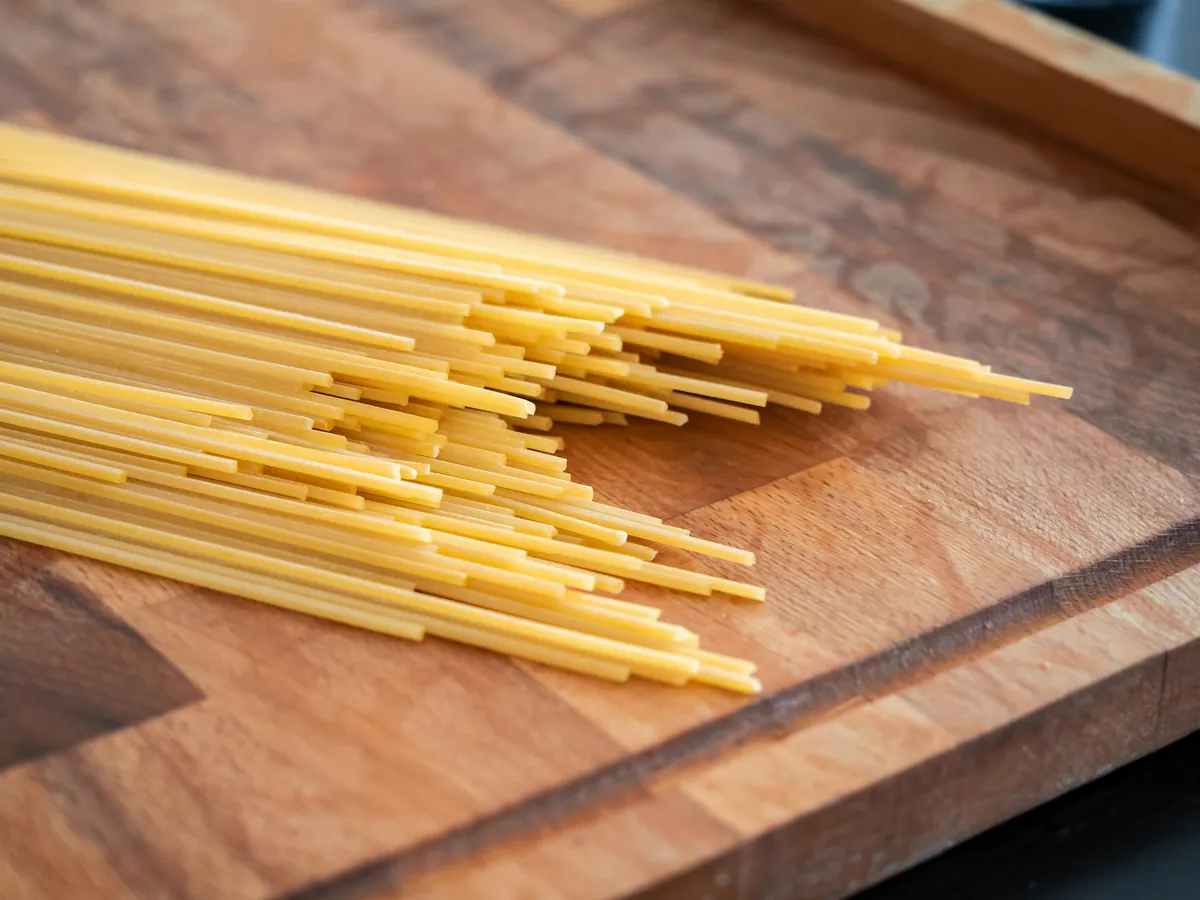
Break long spaghetti in half so it lies flat in the bowl and stays under the water. Photo by Andrea Riezzo on Unsplash - 02
Microwave uncovered on high
Set the bowl on a large plate to catch any overflow and microwave on full power, uncovered, for half the total time. A lid or plastic wrap traps steam and pushes the foam up and over the rim, so leave the bowl open.
- 03
Stir halfway
Use oven mitts to open the door and give the pasta a good stir, scraping the bottom where pieces settle. The water should be at or near a boil. If it has dropped below the top of the pasta, add hot water to cover it again.
- 04
Finish and taste
Microwave for the remaining time, stirring once more if your oven has no turntable. About 2 minutes before the end, fish out a piece and bite it. It should be tender with a slight firmness in the center. If it is still chalky, continue in 1-minute bursts.
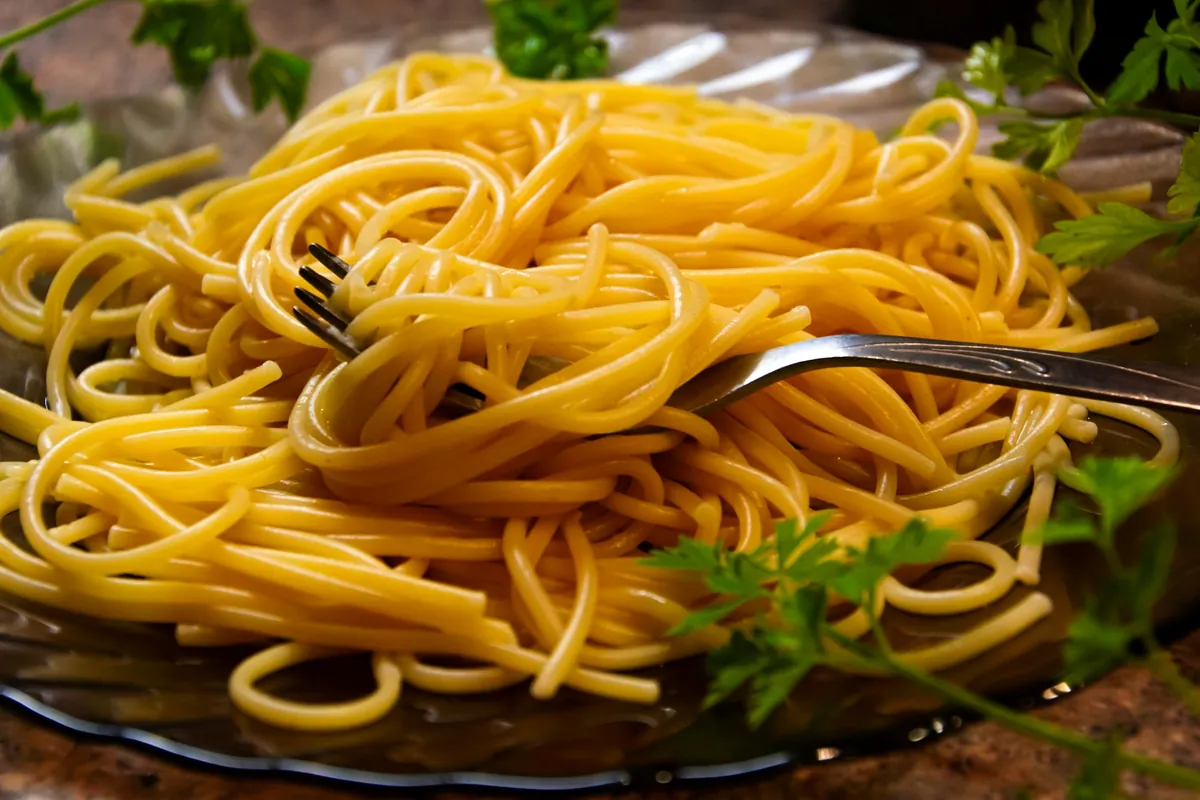
Taste a piece before the timer ends. The center should be tender with a little bite. Photo by Christine Sandu on Unsplash - 05
Rest, drain and sauce
Leave the bowl in the microwave for 1 minute so the boiling settles. Lift it out with mitts, carry it to the sink and pour it into a colander, tipping the bowl away from you so the steam rolls the other way. Save a few tablespoons of the starchy water to loosen your sauce.
Plenty of water and a stir at the halfway point prevent most microwave pasta problems. Sauce the pasta right away. A quick option is our pasta sauce from tomato paste, which comes together in about the same time the pasta takes.
Microwave Pasta Times by Shape
The chart below applies the package-plus-3-minutes rule to common dried shapes, for 1 to 2 servings in a microwave of about 1,000 to 1,100 watts. Package times vary between brands, so treat the stovetop column as a typical range and use the number on your box when you have it.
| Pasta shape | Typical package time | Microwave time on high | Notes |
|---|---|---|---|
| Spaghetti, broken in half | 9 to 11 minutes | 12 to 14 minutes | Stir well at the start; strands stick as they soften |
| Penne | 10 to 12 minutes | 13 to 15 minutes | Tubes trap water, so shake well when draining |
| Elbow macaroni | 7 to 8 minutes | 10 to 11 minutes | Small and quick; check early |
| Rotini | 8 to 10 minutes | 11 to 13 minutes | Twists cook evenly and hold sauce well |
| Farfalle | 11 to 13 minutes | 14 to 16 minutes | The pinched centers cook last; taste one there |
| Orzo | 8 to 10 minutes | 10 to 12 minutes | Use a fine-mesh sieve to drain |
| Dried egg noodles | 6 to 8 minutes | 9 to 11 minutes | Foam more than plain pasta; use a bigger bowl |
The extra 3 minutes is a starting point, not a precise conversion. Thin or small shapes such as orzo and angel hair often need only 2 extra minutes, while thick shapes like rigatoni can need 4. Start tasting 2 minutes before the chart time and keep going in 1-minute bursts.
Adjusting Times for Microwave Wattage
Microwave power varies widely, from compact 700-watt models to 1,200-watt countertop ovens. The wattage is usually printed on a label inside the door, on the back panel or in the manual. Most microwave recipes, including the chart above, assume about 1,000 watts.
Cooking time scales roughly in reverse with power. A lower-wattage oven takes longer to bring the water to a boil and to keep it there, so the whole cook stretches out.
| Microwave power | Adjustment | Example: penne, 1 serving |
|---|---|---|
| 700 watts | Add about 30 to 40 percent | About 18 to 20 minutes |
| 800 to 900 watts | Add about 10 to 20 percent | About 15 to 17 minutes |
| 1,000 to 1,100 watts | Use the chart times as written | About 13 to 15 minutes |
| 1,200 watts and above | Subtract about 10 to 15 percent | About 11 to 13 minutes |
These are estimates. Bowl material and starting water temperature also shift the result, so the taste test is the final word.
A useful shortcut for slow microwaves: start with water from a kettle. When the water is already boiling, most of the extra time disappears, and the pasta needs close to its package time. Pour the hot water over the pasta carefully, stir and microwave right away.
Water Ratio Chart for 1, 2 or 4 Servings
A standard serving of dried pasta is 2 ounces (57 g), about 1/2 cup of short shapes. The water needs to cover the pasta by 1 to 2 inches for the whole cook, and the bowl needs space above that for foam.
| Servings | Dried pasta | Cold water | Salt | Bowl size | Time |
|---|---|---|---|---|---|
| 1 | 2 ounces (57 g) | About 2 cups (480 ml) | 1/2 teaspoon | 2 quarts (2 L) | Package time plus 3 minutes |
| 2 | 4 ounces (113 g) | 3 to 4 cups (720 to 950 ml) | 1 teaspoon | 2 1/2 to 3 quarts (2.4 to 2.8 L) | Package time plus 3 to 5 minutes |
| 4 | 8 ounces (227 g) | 6 to 7 cups (1.4 to 1.7 L) | 1 1/2 to 2 teaspoons | 4 quarts (3.8 L) or larger | Package time plus 8 to 10 minutes, or start with boiling water |
The four-serving row shows why the microwave works best for small batches. Doubling the water roughly doubles the time it takes to reach a boil, and a bowl big enough to hold 7 cups of water safely may not fit on your turntable. If you do cook four servings, start with kettle-boiled water and stir every 3 minutes.
Need cold pasta instead? Cook it the same way, rinse it under cold water and use it in our classic pasta salad.
How to Stop Pasta Boiling Over
Pasta boils over because starch leaches into the water and stabilizes the bubbles, building a foam that climbs the sides of the bowl. In a microwave, heating is uneven, so some spots boil hard while others barely simmer. A small bowl turns that foam into a puddle on the turntable.
- Use a bigger bowl. Keep the water at or below the halfway mark. This one change solves most boil-overs.
- Leave it uncovered. A lid traps steam and pressure under the foam. If you want to limit splatter, rest a microwave-safe plate loosely on top with a wide gap.
- Lower the power after the boil. Once the water is boiling at the halfway stir, switch to 70 percent power for the rest of the time and add 1 to 2 minutes. The water stays at a steady simmer with far less foam.
- Set a plate underneath. It will not stop foam, but it turns a cleanup job into a quick rinse.
- Stir more often. Stirring knocks down foam and redistributes the hot spots.
The wooden spoon trick: myth or real?
On the stove, a wooden spoon laid across a pot can pop the first bubbles that reach it, because the dry surface breaks the foam as it rises. The effect is real but short-lived: once the spoon is wet and hot, foam rolls right past it. In a microwave it is even less useful, since the bowl turns and the door limits what fits on top. Leave the spoon out and rely on bowl size and power level.
Mug Pasta and Microwave Mac and Cheese
For a single quick meal, cook small pasta right in the mug you eat from, letting it absorb most of the water instead of draining it.
Mug Pasta for One
Choose a large microwave-safe mug that holds at least 14 ounces (415 ml). Add 1/3 cup (about 1 1/2 ounces or 40 g) of small pasta such as elbows, ditalini or small shells, 1/2 cup (120 ml) water and a pinch of salt. Set the mug on a plate and microwave on high for 2 minutes, then stir.
Continue in 1-minute bursts, stirring each time, until the pasta is tender and almost all the water is absorbed. This usually takes 4 to 6 minutes in total. If the mug runs dry before the pasta is done, add 2 tablespoons of water and keep going. Stir in a spoonful of pesto, butter and Parmesan, or warm marinara, and eat it straight from the mug.

Microwave Mac and Cheese
For one mug, cook the pasta as above. When the water is nearly absorbed, stir in 2 to 3 tablespoons of milk and 1/4 cup (28 g) shredded cheddar, then microwave for 30 to 40 seconds and stir until creamy. A pinch of mustard powder or a little black pepper sharpens the cheese flavor.
For two servings, cook 4 ounces (113 g) of elbow macaroni with the main method and drain, keeping 2 tablespoons of the cooking water in the bowl. Add 1/3 cup (80 ml) milk, 1 tablespoon butter and 1 cup (113 g) shredded cheddar. Microwave for 30 seconds, stir, then repeat in 20-second bursts until the cheese melts into a smooth sauce. Short bursts matter, because cheese overheated in the microwave turns grainy and oily.
For a richer, stovetop version built on a proper cheese sauce, start with the bechamel in our white sauce pasta and stir in cheddar.
Microwave Pasta Safety
Treat the bowl like a pot of boiling water, because that is what it is.
- Use the right container. Choose glass or ceramic labeled microwave-safe. Avoid metal, dishes with metallic trim, thin takeout containers and old margarine tubs, which can warp or melt with long heating. Plastic is fine only if it is labeled microwave-safe.
- Never seal it. Do not microwave pasta in a closed container or under a tight lid. Steam needs a way out.
- Add the pasta and salt before heating. Plain water heated alone in a clean, smooth container can become superheated, rising above boiling point without bubbling, then erupt when it is disturbed. The FDA notes that adding something to water before heating greatly reduces this risk, which is one more reason to start with the pasta already in the bowl.
- Handle it with mitts. A bowl holding boiling water gets very hot. Use oven mitts or a folded towel on both sides, and let the bowl stand for 1 minute before lifting it out.
- Mind the steam. When you lift a plate cover or drain, tip everything away from your face and hands. Steam burns happen faster than most people expect.
Reheating Cooked Pasta in the Microwave
Cooked pasta keeps in the fridge for 3 to 4 days. Cool it and refrigerate it within 2 hours, in a shallow airtight container.
To reheat plain or sauced pasta, put it in a microwave-safe bowl and add about 1 tablespoon of water or milk per cup of pasta. That moisture turns to steam and keeps the pasta from drying into a hard crust. Cover loosely with a microwave-safe plate or a damp paper towel and heat on high in 1-minute bursts, stirring between each, until it is hot all the way through.
USDA guidance on leftovers and food safety is to reheat leftovers to 165°F (74°C), checking in more than one spot because microwaves leave cold patches. Stirring is what evens those out.
Cream sauces need gentler handling. Reheat them at 50 percent power with a splash of milk so the sauce does not separate. The same approach works for leftover fettuccine Alfredo, which tightens in the fridge. Tomato-sauced pasta is more forgiving and can go on full power. A spoonful of basil pesto stirred in after reheating brings tired leftovers back to life.
Troubleshooting: Gummy, Crunchy or Foamy Pasta
Most problems come down to water, time or stirring.
| Problem | Likely cause | Fix |
|---|---|---|
| Gummy or sticky | Too little water, overcooking, or pasta left sitting in hot water | Use water 2 inches above the pasta, taste earlier and drain as soon as it is ready |
| Clumped together | No stir at the start or halfway | Stir once before cooking and again at the halfway point |
| Crunchy or chalky center | Not enough time, low wattage or pieces sticking out of the water | Add water to cover and cook in 1-minute bursts until tender |
| Hard ends on spaghetti | Strands above the water line | Break spaghetti in half or use a rectangular baking dish |
| Foaming over | Bowl too small, lid on, or power too high | Use a bigger bowl, cook uncovered and drop to 70 percent power after the boil |
| Uneven, some soft and some firm | Hot spots, especially without a turntable | Stir every 3 to 4 minutes and rotate the bowl by hand |
| Bland | No salt in the water | Salt the water next time; for now, season the sauce well |
Pasta that ran dry and stuck to the bottom of the bowl is usually fine in the middle. Add hot water, stir and let it stand for a minute to release the stuck pieces. Overcooked pasta cannot be firmed up again, but a hearty sauce like our homemade spaghetti sauce hides a soft texture well.
Microwave Pasta FAQs
How long does it take to cook pasta in the microwave?
Most dried pasta takes the package cooking time plus about 3 minutes on high in a 1,000-watt microwave. For 1 to 2 servings that usually means 10 to 16 minutes depending on the shape. Lower-wattage microwaves need longer, so taste the pasta 2 minutes before the end and continue in 1-minute bursts.
How much water do you need to cook pasta in the microwave?
Cover the pasta with cold water by 1 to 2 inches. For one 2-ounce serving that is about 2 cups of water, and for two servings 3 to 4 cups. The pasta roughly doubles in size as it cooks, so too little water leaves hard, uncooked pieces.
Should you cover pasta when cooking it in the microwave?
No. Cook it uncovered. A lid or plastic wrap traps steam and pushes starchy foam over the rim of the bowl. If you want to limit splatter, rest a microwave-safe plate loosely on top and leave a wide gap for steam.
Can you cook spaghetti in the microwave?
Yes. Break the spaghetti in half so it fits under the water in a round bowl, or lay it flat in a rectangular glass baking dish. Stir well at the start and halfway, because the strands stick together as they soften.
Why does pasta boil over in the microwave?
Starch from the pasta stabilizes the bubbles in boiling water and creates foam that rises up the bowl. Use a bowl at least twice the volume of the water, cook uncovered and switch to 70 percent power once the water is boiling to keep the foam down.
Is it safe to cook pasta in a plastic container in the microwave?
Only if the container is labeled microwave-safe. Thin takeout boxes and reused tubs can warp or melt during a long cook in boiling water. Glass or ceramic bowls labeled microwave-safe are the better choice for cooking pasta.
Can you cook fresh pasta in the microwave?
You can, but it cooks fast and turns soft easily. Fresh pasta needs only 2 to 4 minutes once the water boils, so start with kettle-boiled water, add the pasta, microwave in 1-minute bursts and taste after each one.
The recipe
Basic Microwave Pasta
Dried pasta cooked in a large bowl in the microwave, with no stove and no big pot. Serves 1 to 2.
Ingredients
Instructions
- Choose a big bowl. Use a microwave-safe glass or ceramic bowl that holds at least 2 1/2 quarts (2.4 L), so the water fills no more than about half of it. Set it on a large plate.
- Add pasta, water and salt. Add the pasta, breaking long shapes in half. Pour in cold water to cover the pasta by about 2 inches, add the salt and stir once to separate the pieces.
- Microwave half the time. Microwave uncovered on high for half of the package cooking time plus 3 minutes. For pasta with a 10-minute package time, that is about 6 1/2 minutes.
- Stir and continue. Stir well, scraping the bottom, and top up with hot water if the pasta is not covered. Microwave for the remaining time, stirring once more if your oven has no turntable.
- Taste and adjust. About 2 minutes before the end, taste a piece. If the center is still firm, continue in 1-minute bursts until tender with a slight bite.
- Rest, drain and serve. Let the bowl stand in the microwave for 1 minute. Lift it out with oven mitts, reserve a few tablespoons of cooking water and drain in a colander, tipping the bowl away from you. Toss with your sauce and serve.
Notes
For one serving, use 2 ounces (57 g) pasta, about 2 cups (480 ml) water and 1/2 teaspoon salt. Times assume a 1,000 to 1,100-watt microwave: add about 30 to 40 percent at 700 watts and subtract 10 to 15 percent at 1,200 watts. Cooked pasta keeps for 3 to 4 days in the fridge. Estimated nutrition per serving of plain cooked pasta, before sauce, is about 200 calories, 7 g protein, 42 g carbohydrate and 1 g fat, based on 2 ounces of dried pasta. Values change with your pasta and sauce.