
In this recipe
- What Makes This Gluten-Free Pasta Recipe Hold Together
- Ingredients and the Flour Blend
- Xanthan Gum or Psyllium?
- How to Make Gluten-Free Pasta Dough
- Why Gluten-Free Pasta Cracks and How to Fix It
- Rolling by Hand vs a Pasta Machine
- Shapes and Cooking Times
- Best Sauces for Fresh Gluten-Free Pasta
- Celiac Safety: Avoiding Cross-Contact
- Storing and Freezing
- Gluten-Free Pasta Nutrition
- Gluten-Free Pasta FAQs
- Printable Recipe Card
This gluten-free pasta recipe makes fresh egg pasta that rolls, cuts and cooks like the real thing. The dough uses a simple blend of white rice flour, tapioca starch and potato starch. Xanthan gum and four eggs hold it together, so it bends through a pasta machine instead of crumbling. It serves 4 and the noodles cook in about 3 minutes.
Most gluten-free pasta fails for one reason: nothing replaces the stretch that gluten gives wheat dough. As a result, sheets crack at the edges, tear on the rollers and break apart in the pot. This recipe fixes that with the right ratio of flour to starch, enough binder and a dough that is moist but not sticky.
Below: what each ingredient does, a xanthan gum or psyllium option, a step-by-step method, how to fix cracking dough, rolling by hand or machine, shapes and cooking times, celiac cross-contact tips, and how to store and freeze it.
What Makes This Gluten-Free Pasta Recipe Hold Together
Wheat pasta holds together because gluten proteins form a stretchy network when flour meets egg. Gluten-free flours have no such network. So the dough needs three things to take its place.
- A blend, not a single flour. Rice flour alone makes a sandy, brittle dough. Adding tapioca and potato starch gives the sheets stretch and a smoother, more tender bite.
- A binder. Xanthan gum or psyllium husk forms a gel that holds the starch together. It is the closest thing to gluten in this recipe, and it is not optional.
- Extra egg. Many wheat pasta recipes use about 1 egg per 100 g of flour. This one uses 4 eggs for 285 g of flour and starch. Egg proteins set as the pasta cooks, which keeps the noodles in one piece.
The ratio here follows the same pattern used by tested gluten-free recipes: roughly three parts rice flour to one part starch, about 1 tablespoon of xanthan gum and 4 large eggs. A little olive oil makes the dough easier to roll.
Ingredients and the Flour Blend

Weigh the flours if you can. Gluten-free flours pack very differently into a cup, so grams give far more reliable results than cups. The cup measures below are approximate.
| Ingredient | Weight | Approx. volume | What it does |
|---|---|---|---|
| White rice flour | 190 g | 1 1/3 cups | Structure and body |
| Tapioca starch | 55 g | 1/2 cup | Stretch and chew |
| Potato starch | 40 g | 1/4 cup | Tenderness and a silky surface |
| Xanthan gum | Measure by spoon | 1 tablespoon, level | Binds the dough in place of gluten |
| Large eggs | About 200 g | 4 eggs | Moisture, protein and color |
| Olive oil | 13 g | 1 tablespoon | Makes rolling easier |
| Fine salt | About 3 g | 1/2 teaspoon | Seasons the dough |
- Rice flour. Use finely milled white rice flour. Coarse rice flour makes a gritty, crumbly dough. Brown rice flour works too, with a nuttier taste and a slightly darker color.
- Tapioca starch. Also sold as tapioca flour. It is the same product, so either label works.
- Potato starch. Look for potato starch, a fine white powder. Potato flour is a different, heavier product that absorbs much more liquid.
- Eggs. Use large eggs at room temperature. Egg size changes the dough, which is why the water is added only as needed.
Prefer a ready-made blend? A store-bought gluten-free all-purpose flour can stand in for the three flours, weight for weight. Check the label first. Many blends already contain xanthan gum, so you may only need about 1 teaspoon extra.
Xanthan Gum or Psyllium?

Both binders work. They just give slightly different pasta.
- Xanthan gum (the default). It gives smooth, pale, elastic sheets that cut cleanly. One tablespoon is plenty for this batch. Measure it level, because too much makes the cooked pasta slippery and gummy.
- Psyllium husk powder. It is a plant fiber that forms a strong gel with water. Use about 15 g in place of the xanthan gum, and add 2 to 4 tablespoons of warm water with the eggs. Then cover the dough and let it rest for 15 minutes so the psyllium can absorb the water. The pasta is a little darker, firmer and more rustic.
Use psyllium powder, not whole husks, which leave flecks and a grainy texture. Whichever you choose, mix it into the dry ingredients first so it spreads evenly. Clumps of binder turn into gummy spots.
How to Make Gluten-Free Pasta Dough
Plan on about 40 minutes of hands-on time, most of it rolling and cutting. A food processor speeds up the mixing, but a bowl and a fork work fine.
- 01
Blend the dry ingredients
Whisk the rice flour, tapioca starch, potato starch, xanthan gum and salt in a large bowl. Alternatively, pulse them in a food processor. The binder must be evenly spread before any egg goes in.
- 02
Add the eggs and oil
Make a well, add the eggs and olive oil, and stir with a fork until shaggy clumps form. In a food processor, process for about 10 seconds, until the dough pulls together.
- 03
Knead briefly and check the texture
Knead on a clean counter for about 1 minute. The dough should feel smooth and pliable, like soft modeling clay. If it cracks, knead in water 1 teaspoon at a time. If it sticks, dust it with rice flour.
- 04
Divide and cover
Roll the dough into a log and cut it into 6 equal pieces. Wrap them in plastic wrap or cover them with an upturned bowl. Gluten-free dough dries quickly in open air.
- 05
Roll the first sheet
Flatten one piece into a rectangle. Pass it through the widest setting of a pasta machine. Fold it in thirds, press it, and pass it through again. Repeat 2 or 3 times, until the edges look clean. Then thin it one setting at a time.
- 06
Cut the pasta
Stop one or two settings before the thinnest, when the sheet is thin enough to see the outline of your hand through it. Cut it into fettuccine with the machine cutter, or by hand with a sharp knife.
- 07
Cook right away, or hold briefly
Dust the noodles with rice flour and lay them on a lined tray, loosely covered. Cook them within 2 hours, or freeze them. Boil in well-salted water for 2 to 4 minutes and taste often.
Do not try to knead it smooth like wheat dough. Without gluten, extra kneading does nothing. Moisture is what turns a crumbly dough into a smooth one, so adjust the water instead.
Why Gluten-Free Pasta Cracks and How to Fix It
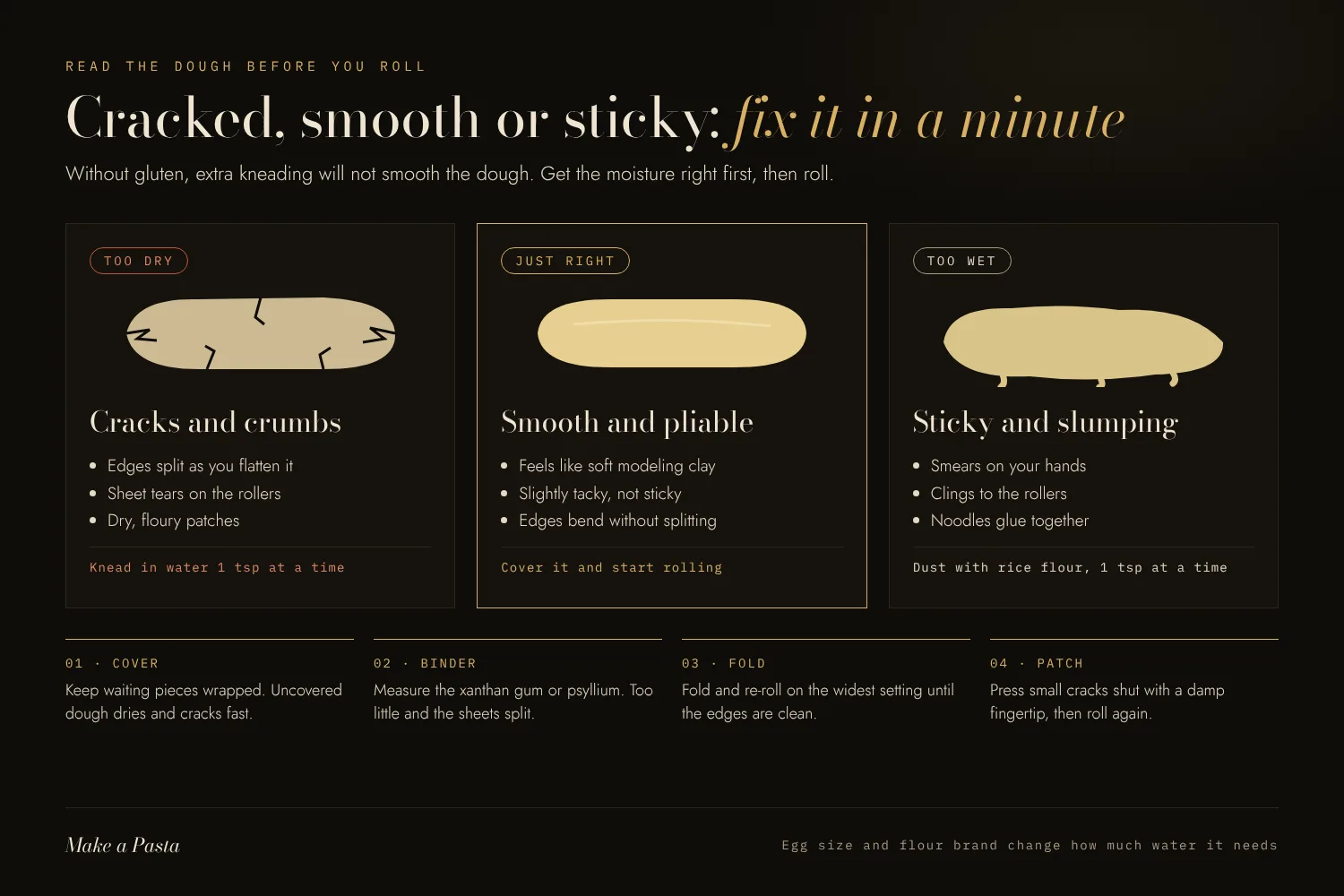
Cracking is the most common problem with any gluten-free pasta recipe. In most cases the dough is simply too dry. Gluten-free flours keep absorbing liquid for a few minutes after mixing, so a dough that felt fine at first can turn stiff.
| Problem | Likely cause | Fix |
|---|---|---|
| Edges crack while rolling | Dough too dry | Knead in water 1 teaspoon at a time |
| Sheets tear on the rollers | Rolled too thin too fast | Fold and re-roll on the widest setting, then thin gradually |
| Dough crumbles apart | Too little binder, or it was not mixed in | Measure the xanthan gum and whisk it into the dry mix |
| Surface dries and cracks | Pieces left uncovered | Keep every waiting piece wrapped |
| Sticky dough that smears | Too much water or large eggs | Dust with rice flour, 1 teaspoon at a time |
| Noodles break in the pot | Overcooked or boiled too hard | Cook 2 to 4 minutes at a steady boil and stir gently |
| Gummy, slippery noodles | Too much xanthan gum | Use a level 1 tablespoon for this batch |
Small cracks are easy to repair. Press them shut with a damp fingertip, then fold the sheet and pass it through the widest setting again. If a whole piece keeps crumbling, return it to the bowl, add a few drops of water and knead it back together.
Rolling by Hand vs a Pasta Machine

You can make this dough with either tool. However, they suit different shapes.
With a pasta machine
A hand-crank or stand-mixer roller gives thin, even sheets with far less tearing. Gluten-free dough is less elastic than wheat dough, so the even pressure of the rollers helps a lot. Start on the widest setting and fold the sheet a few times to square the edges. Then thin it one notch at a time, passing it once or twice per setting. If the sheet gets too long to handle, cut it in half.
Most gluten-free sheets work best when you stop one or two settings before the thinnest. Very thin gluten-free sheets are fragile and can tear when cut.
With a rolling pin
Roll each piece between two sheets of parchment paper. The paper stops the dough sticking and lets you peel it off without tearing. Roll from the center outward and turn the dough often. Aim for about 1/16 inch, thin enough to see light through it.
Hand-rolled sheets are rarely as thin or even as machine sheets. Therefore, choose shapes that suit a slightly thicker sheet: pappardelle, lasagna sheets, farfalle or simple squares for soup. Cut them with a sharp knife or a pizza wheel rather than a dull blade, which drags and splits the edges.
Shapes and Cooking Times

Flat shapes are the easiest with gluten-free dough. Filled pasta works too, but keep the sheets a little thicker and seal the edges with a dab of water.
| Shape | How to cut | Cook time |
|---|---|---|
| Fettuccine or tagliatelle | Machine cutter, or knife cuts about 1/4 inch wide | 2 to 3 minutes |
| Pappardelle | Hand cut, about 3/4 inch wide | 2 to 4 minutes |
| Lasagna sheets | Cut to fit your baking dish | Layer uncooked, or boil 1 minute |
| Farfalle | 1 1/2 inch rectangles, pinched in the center | 3 to 4 minutes |
| Ravioli | Two sheets, filled and sealed with water | 3 to 4 minutes |
| Frozen noodles | Straight from the freezer, no thawing | 4 to 6 minutes |
To cook, bring a large pot of water to a rolling boil and salt it well. Add the pasta, stir gently, and start timing when the water returns to a boil. Taste early. Gluten-free pasta goes from tender to soft quickly, and overcooked noodles can break up. Lift long noodles out with tongs instead of pouring them into a colander, which is gentler on them.
Best Sauces for Fresh Gluten-Free Pasta
Fresh gluten-free noodles are delicate, so they suit sauces that coat rather than smother. Save a cup of the cooking water. It is starchy and helps bind the sauce, just as it does with wheat pasta.
- Butter and cheese. A glossy garlic butter pasta sauce or a classic fettuccine Alfredo pairs naturally with fresh ribbons.
- Herb sauces. A basil pesto pasta sauce clings well to thin fettuccine.
- Tomato sauces. A slow-cooked homemade spaghetti sauce suits pappardelle, and a quick pasta sauce from tomato paste works on busy nights.
- Cream sauces. For a creamy pasta sauce, use the reduction method rather than a wheat flour roux.
Always check every sauce ingredient, too. Stock, bouillon, soy sauce and some cheese products can contain wheat. Find more ideas in our pasta recipes.
Celiac Safety: Avoiding Cross-Contact
For people with celiac disease, the only treatment is a strict, lifelong gluten-free diet. The Celiac Disease Foundation notes that even small amounts, such as crumbs on a cutting board, can trigger intestinal damage. So homemade pasta is only as safe as the kitchen it is made in.
- Buy labeled ingredients. Choose rice flour, starches and binders labeled gluten-free. Under the FDA’s gluten-free labeling rule, a food labeled gluten-free must contain less than 20 parts per million of gluten. The label is voluntary, so an unlabeled flour may still be fine, but the label gives you that assurance.
- Clean the work surface. Wheat flour is fine and travels. Wipe the counter, bowls and tools well, and avoid making this right after working with wheat flour in the same space.
- Think about the pasta machine. Rollers and cutters are hard to clean fully, because water damages most of them. If the machine has been used for wheat pasta, many celiac households keep a separate one for gluten-free dough.
- Use fresh water and a clean colander. Never cook gluten-free pasta in water used for wheat pasta. Celiac guidance from children’s hospitals also advises a separate colander, or straining the gluten-free food first.
- Skip wooden tools in a shared kitchen. It is unclear whether gluten can be fully cleaned from wood grain. Many families keep separate wooden spoons and boards, or use plastic, glass or metal instead.
- Store gluten-free flours above wheat. That way, no stray flour can fall into them.
If you are cooking for someone with celiac disease, ask how strict their needs are. When in doubt, a doctor or registered dietitian can give personal advice.
Storing and Freezing
Fresh gluten-free pasta is best cooked the day you make it. Raw egg dough is perishable, so follow the usual food safety limits.
- At room temperature. Keep the cut pasta loosely covered on a floured tray and cook it within 2 hours.
- In the fridge. Cover the tray or store the noodles in an airtight container, and cook them within about 1 day. They may darken slightly, but they are fine to use.
- In the freezer. Spread the cut pasta in a single layer on a lined tray and freeze it for about 1 hour, until firm. Then move it to a freezer bag. Do not twist it into tight nests first, because they are hard to separate later. For the best texture, use it within about 2 weeks. Cook it straight from frozen.
- Drying. Air-drying is not recommended. Gluten-free noodles tend to turn brittle and crack as they dry.
Cooked leftovers keep in the fridge for 3 to 4 days in a shallow airtight container. Reheat them gently with a splash of water until hot all the way through, to 165°F (74°C). Gluten-free pasta can firm up in the fridge, so warm it with the sauce rather than on its own.
Gluten-Free Pasta Nutrition
These figures are approximate. They were calculated from ingredient values in the USDA’s FoodData Central database, for the pasta only, divided into 4 servings. They do not include sauce, the salt in the cooking water or the xanthan gum, which adds a little soluble fiber.
| Nutrient | Amount | Main sources |
|---|---|---|
| Calories | About 365 | Rice flour and starches |
| Protein | About 9 g | Eggs and rice flour |
| Carbohydrate | About 60 g | Rice flour and starches |
| Fat | About 9 g | Eggs and olive oil |
| Saturated fat | About 2 g | Eggs |
| Fiber | About 1 g | Rice flour |
Starch-based gluten-free pasta is usually lower in protein and fiber than whole wheat pasta. To make a fuller meal, serve it with a protein, such as chicken, shrimp or white beans, and plenty of vegetables. Brown rice flour also adds a little more fiber than white.
Gluten-Free Pasta FAQs
Why does my gluten-free pasta dough keep cracking?
Cracking usually means the dough is too dry or has too little binder. Knead in water 1 teaspoon at a time until the dough feels like soft modeling clay, keep the waiting pieces wrapped, and measure the xanthan gum or psyllium carefully.
Can I make gluten-free pasta without xanthan gum?
Yes. Psyllium husk powder is the most common swap. Use about 15 g for this batch, add 2 to 4 tablespoons of warm water and let the dough rest for 15 minutes so the psyllium can absorb it. The pasta comes out a little darker and more rustic.
Can I use a store-bought gluten-free flour blend?
Yes, but results vary by brand. Use 285 g of the blend and check the label: if it already contains xanthan gum, reduce the added gum to about 1 teaspoon. Adjust with water or extra flour until the dough feels pliable.
Do I need a pasta machine to make gluten-free pasta?
No, but it helps. A machine rolls thinner, more even sheets with less tearing. By hand, roll the dough between two sheets of parchment to about 1/16 inch and cut wider shapes such as pappardelle, lasagna sheets or farfalle.
How long do you cook fresh gluten-free pasta?
Most fresh gluten-free pasta cooks in 2 to 4 minutes once the water returns to a boil. Thin fettuccine is often ready in 2 to 3 minutes. Frozen pasta needs about 4 to 6 minutes. Taste early, because it turns soft and can break if it overcooks.
Does fresh gluten-free pasta need to rest?
Not for the gluten, because there is none to relax. A short rest only helps when you use psyllium, which needs about 15 minutes to absorb water. Otherwise, roll it right away and keep it covered.
Can you freeze homemade gluten-free pasta?
Yes. Freeze the cut pasta in a single layer on a lined tray for about 1 hour, then move it to a freezer bag. Cook it straight from frozen. For the best texture, use it within about 2 weeks.
Is homemade gluten-free pasta safe for celiac disease?
It can be, if every ingredient is gluten-free and you prevent cross-contact. Choose flours, starches and binders labeled gluten-free, clean your counter and tools, and cook the pasta in fresh water in a clean pot. Ask your doctor or dietitian if you are unsure.
The recipe
Fresh Gluten-Free Egg Pasta
A pliable gluten-free pasta dough made with rice flour, tapioca starch and potato starch, bound with xanthan gum and eggs. It rolls by machine or by hand and cooks in about 3 minutes. Serves 4.
Ingredients
Instructions
- Mix the dry ingredients. Whisk the rice flour, tapioca starch, potato starch, xanthan gum and salt in a large bowl, or pulse them in a food processor, until evenly blended.
- Add the eggs and oil. Add the eggs and olive oil. Mix with a fork, or process for about 10 seconds, until the dough clumps and pulls together.
- Knead and check the texture. Knead on the counter for about 1 minute, until smooth and pliable like soft modeling clay. If it cracks, knead in water 1 teaspoon at a time. If it sticks, dust it with rice flour.
- Divide and cover. Shape the dough into a log, cut it into 6 pieces and wrap them. Work with one piece at a time so the rest does not dry out.
- Roll the sheets. Flatten a piece, then pass it through the widest machine setting. Fold it in thirds and pass it again 2 to 3 times, until the edges are clean. Thin it one setting at a time, stopping one or two settings before the thinnest. To roll by hand, roll between two sheets of parchment to about 1/16 inch.
- Cut the pasta. Cut into fettuccine, pappardelle or any shape you like. Dust the pieces with rice flour and lay them on a lined tray, loosely covered.
- Cook and serve. Boil the pasta in a large pot of well-salted water for 2 to 4 minutes, stirring gently, until tender. Save 1 cup of the cooking water, drain and toss with your sauce right away.
Notes
Weigh the flours for the most reliable dough. For a psyllium version, replace the xanthan gum with 15 g psyllium husk powder, add 2 to 4 tablespoons of warm water and rest the dough for 15 minutes before rolling. If you use a store-bought gluten-free flour blend that already contains xanthan gum, use 285 g of it and add only about 1 teaspoon of extra gum. Cook fresh pasta within 2 hours, refrigerate it for up to about 1 day, or freeze it flat and cook from frozen for 4 to 6 minutes. For celiac safety, use ingredients labeled gluten-free and clean tools. Approximate nutrition per serving, pasta only, calculated from USDA ingredient data: about 365 calories, 9 g protein, 60 g carbohydrate and 9 g fat.