
In this guide
- Ravioli Dough: The Classic Egg Pasta Ratio
- How to Make Homemade Ravioli Step by Step
- Ravioli Filling Rules That Prevent Leaks
- Eight Ravioli Filling Ideas With Sauce Pairings
- Rolling by Hand Versus Pasta Machine
- Sealing Methods Compared
- Cooking and Saucing Homemade Ravioli
- Make-Ahead and Freezing
- Common Ravioli Mistakes and How to Fix Them
- Nutrition Estimate
- Homemade Ravioli FAQs
- Printable Recipe
Homemade ravioli needs far less skill than most people assume. The dough is two ingredients, the filling is a bowl of cheese and greens, and the only real technique is sealing each pillow so it survives the pot.
This guide covers the classic ravioli dough ratio, how to drain ricotta so the filling stays dry, how thin to roll the sheets, and how to press out air so nothing bursts. It also compares fork, cutter, stamp and mold sealing, then finishes with sauces, freezing and a troubleshooting table.
Ravioli Dough: The Classic Egg Pasta Ratio
Ravioli dough follows the formula used across northern Italy: 100 grams of flour per large egg. A batch for four means 300 grams of flour (about 2 1/3 cups) and three large eggs, with no water, no oil and only a pinch of salt.
Flour choice: 00 versus all-purpose
Italian 00 flour is milled very fine and gives a silky sheet that rolls thin without tearing. US all-purpose flour works almost as well, though it feels springier and needs a few more minutes of rest. Avoid bread flour, because the extra gluten makes the sheets tough.
Eggs, yolks and the richer dough
Whole eggs give a balanced dough. For a richer, more golden ravioli dough, swap one whole egg for two yolks, so the ratio becomes roughly one egg plus one yolk per 100 grams of flour. The extra fat makes the dough more pliable, but it dries faster, so keep unused pieces covered.
Well method or food processor
The well method in Stage 1 is traditional. A food processor does the same job in under two minutes: pulse flour and eggs until the mixture looks like coarse couscous, then knead for one minute. Both routes produce identical ravioli.
How to Make Homemade Ravioli Step by Step
These stages use 300 grams of flour and three eggs for roughly 36 to 40 two-inch ravioli.
- 01
Stage 1: Mix and knead the dough
Mound the flour on a clean counter and make a wide well in the center. Crack in the eggs, add a pinch of salt, and beat them with a fork, gradually pulling flour from the walls into the egg. When it becomes too thick to stir, scrape everything together and knead: push the dough away with the heel of your hand, fold, rotate, repeat. After 8 to 10 minutes it should feel smooth and almost waxy. Dust in flour if it sticks; wet your hands if it crumbles.
- 02
Stage 2: Rest the dough
Wrap the ball tightly in plastic wrap and leave it on the counter for at least 30 minutes. The rest lets the flour hydrate and relaxes the gluten, so the sheets stretch instead of snapping back.
- 03
Stage 3: Make and chill the filling
Drain 15 ounces (425 g) of whole-milk ricotta in a cheesecloth-lined sieve, ideally overnight. Wilt 5 ounces (140 g) of spinach, cool it, squeeze it dry in a towel and chop it fine. Stir together the ricotta, spinach, 1/2 cup (50 g) grated Parmigiano Reggiano, one egg yolk, a grating of nutmeg, 3/4 teaspoon salt and black pepper. It should taste slightly over-seasoned, because the pasta mutes it. Chill until needed.
- 04
Stage 4: Roll the sheets
Cut the dough into four pieces and keep three covered. Flatten one, dust it, and pass it through the widest setting on your pasta machine. Fold it in thirds like a letter, roll again twice, then work down the settings one notch at a time. Stop at setting 6 or 7 on a KitchenAid roller, which gives a sheet about 1 mm thick. Cover the sheet with a towel while you roll the next.
- 05
Stage 5: Fill and seal
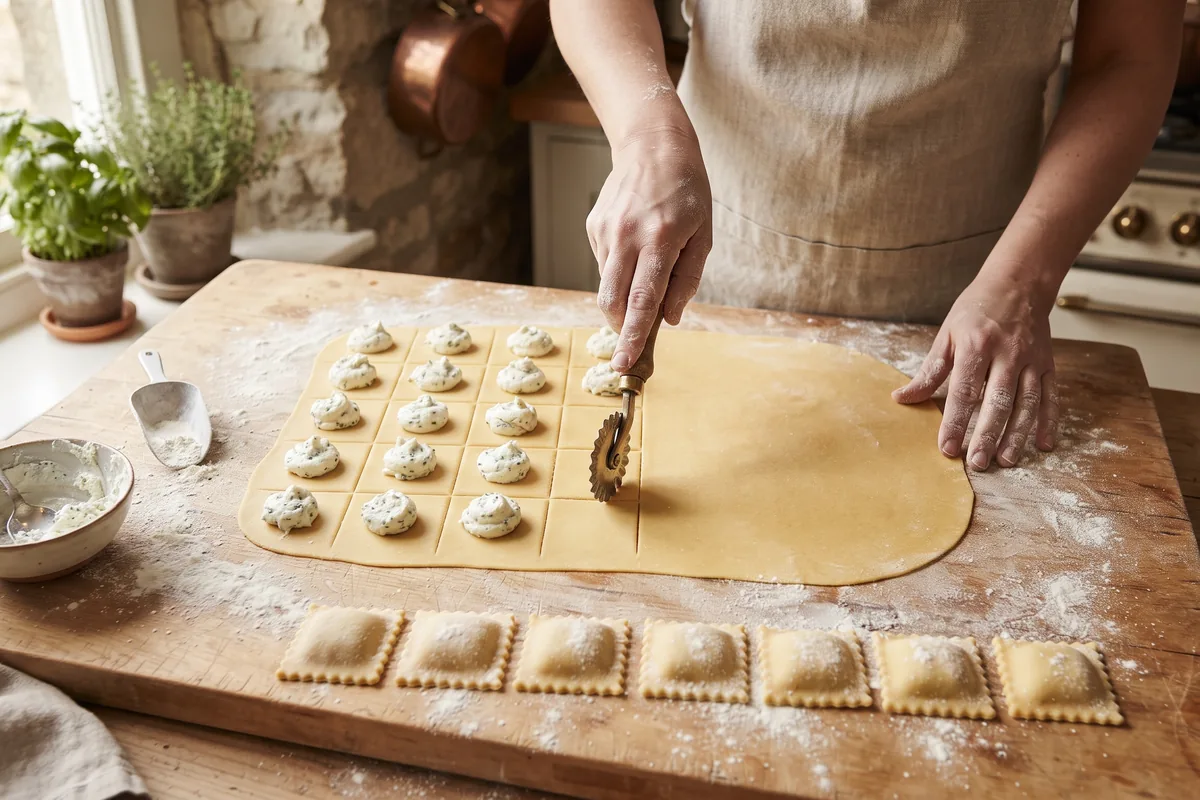
Pipe or spoon 1 to 2 teaspoons of filling in a row, about 2 inches apart, leaving a 1-inch margin. Brush the exposed dough with water or a thin egg wash and drape the second sheet over the top. Then cup your fingers around each mound and press outward toward the edges, pushing every pocket of air out before the seams close. Trapped air turns to steam in the pot and splits the pasta.
- 06
Stage 6: Cut, dry and cook
Cut between the mounds with a fluted pastry wheel, a stamp or a knife, leaving a sealed border of at least 1/4 inch, and press the edges once more with a fork. Set the ravioli on a semolina-dusted tray and air-dry them for 15 to 20 minutes. Bring a large pot of salted water to a gentle boil, add the ravioli in batches, and cook 3 to 4 minutes until the edges taste tender. Lift them out with a slotted spoon straight into warm sauce.
Ravioli Filling Rules That Prevent Leaks
Dry, cold and seasoned
First, remove water from every ingredient: drain ricotta, squeeze greens, roast squash instead of boiling it, and cook meat mixtures until no liquid pools. Second, keep the filling cold so it holds its shape when piped. Third, season assertively. Nutmeg belongs in any dairy-based ravioli filling, and grated Parmigiano both flavors and binds. The thickening ideas in our creamy pasta sauce guide also help a loose filling firm up.
How much filling per ravioli
Use 1 to 2 teaspoons for a 2-inch square; a heaping tablespoon only suits 3-inch ravioli. Overfilling is the most common cause of bursting, because the filling spreads onto the seam. A piping bag gives even portions and keeps the pasta dry.
Eight Ravioli Filling Ideas With Sauce Pairings
Each filling below is matched with the sauce Italian cooks most often serve with it.
| Filling | Key ingredients | Region or style | Best sauce pairing |
|---|---|---|---|
| Ricotta e spinaci | Drained ricotta, squeezed spinach, Parmigiano, nutmeg, egg yolk | Classic across Italy | Brown butter and sage, or simple tomato |
| Butternut squash and amaretti | Roasted squash, crushed amaretti cookies, Parmigiano, nutmeg | Mantua, Lombardy | Brown butter and sage with crumbled amaretti |
| Meat tortelli | Braised beef or pork, mortadella, Parmigiano | Emilia-Romagna | Light broth, or a spoon of slow-cooked ragu |
| Four cheese | Ricotta, fontina, Gorgonzola, Parmigiano | Northern Italy | Walnut cream or bechamel |
| Mushroom and thyme | Sauteed cremini, shallot, mascarpone, thyme | Piedmont style | Brown butter or garlic butter |
| Lemon ricotta | Ricotta, lemon zest, Parmigiano, black pepper | Amalfi inspired | Lemon butter sauce with basil |
| Potato and pecorino | Mashed potato, pecorino, mint | Sardinian culurgiones | Fresh tomato sauce |
| Shrimp and ricotta | Chopped shrimp, ricotta, lemon, chives | Coastal modern | Butter, white wine and a little tomato |
Reading the table
Rich fillings want butter sauces that stay out of the way; lean fillings can take tomato or ragu. A ladle of our slow-cooked pasta bolognese suits meat ravioli, and the sauce from our pasta al limone recipe partners lemon ricotta.
Rolling by Hand Versus Pasta Machine
The 1 mm target
Ravioli dough doubles up at the seams, so it must be thinner than tagliatelle. Aim for about 1 mm, roughly the thickness of a nickel: setting 6 on a KitchenAid roller for a sturdier ravioli, setting 7 for a delicate one. The KitchenAid ravioli tutorial gives the same guidance. Go thinner and the dough tears when you press out air.
Hand rolling tips
Work with a quarter of the dough at a time on a floured board. Roll from the center outward, turning the sheet often, until you can read large print through it. Hand-rolled sheets run slightly thicker, so give those ravioli an extra minute in the pot.
Sealing Methods Compared
Egg wash or water
Water is traditional and works well on fresh, tacky dough. Egg white beaten with a teaspoon of water creates a stronger bond and is safer if the dough has started to dry, if you used a yolk-rich dough, or if you plan to freeze. Avoid whole-egg wash, because yolk fat makes seams slippery. Either way, apply a thin film only where the sheets meet; a wet puddle makes the dough slide.
Fork, cutter, stamp or mold tray
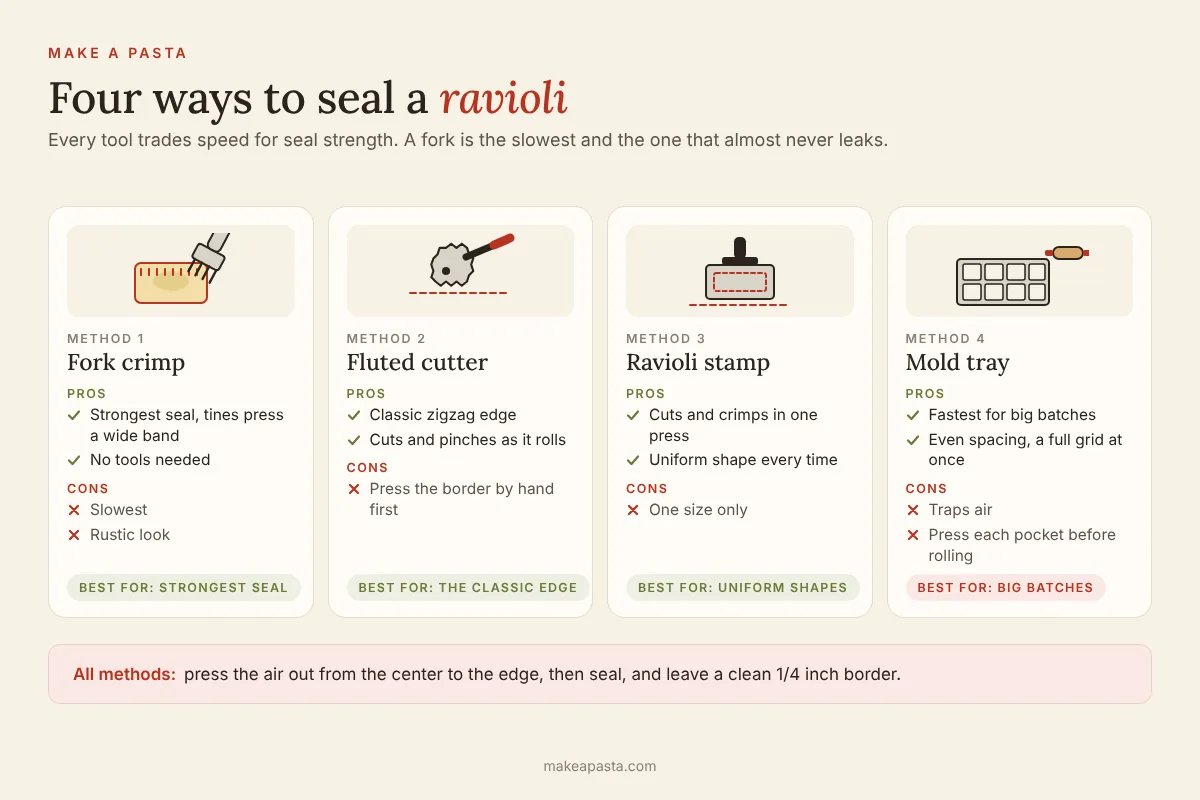
A fork gives the strongest seal, since the tines press the layers together across a wide band. A fluted pastry cutter gives the classic zigzag edge and pinches as it cuts, but you still press the border by hand first. A ravioli stamp cuts and crimps in one motion. A ravioli mold tray holds the bottom sheet in dimples while you fill, then a small rolling pin cuts a full grid at once. Trays suit big batches but trap air, so press each pocket firmly before rolling.
Cooking and Saucing Homemade Ravioli
Boil time and the gentle simmer
Use a wide pot with at least 4 quarts of water and 1 1/2 tablespoons of salt. Bring it to a boil, then lower to a strong simmer, because a rolling boil knocks ravioli together and opens seams. Cook about a dozen at a time for 3 to 4 minutes. They float within the first minute, so floating alone is not the signal; taste a corner of dough at the seam. Lift them out with a spider rather than pouring into a colander.
Three sauces that respect the filling
Brown butter and sage is the classic: melt 6 tablespoons of butter over medium heat, add 10 sage leaves, and cook until the milk solids turn hazelnut brown, about 3 minutes. Toss the ravioli in it with a splash of pasta water. For tomato, use the base from our homemade spaghetti sauce, thinned so it coats rather than buries. For cream, a light bechamel like our white sauce pasta recipe suits mushroom or four-cheese fillings. Skip egg sauces like carbonara, which are built for strands.
Make-Ahead and Freezing
Freeze on trays, then bag
Lay the shaped ravioli in a single layer on a parchment-lined, semolina-dusted sheet pan with none touching. Freeze uncovered for 1 to 2 hours until hard, then bag them with the air pressed out. They keep well for 2 months and acceptably for up to 6. Cook straight from frozen, adding 1 to 2 minutes; thawed ravioli turn soft and the filling weeps into the dough.
Fridge limits
Fresh ravioli can wait up to 4 hours in the refrigerator on a semolina-dusted tray under a towel. After that, moisture migrates into the dough and the bottoms turn grey and sticky, so freeze them instead. Wrapped dough keeps 24 hours, and the filling keeps 2 days.
Common Ravioli Mistakes and How to Fix Them
Nearly every homemade ravioli problem fits one of these patterns.
| Problem | Likely cause | Fix |
|---|---|---|
| Ravioli burst in the pot | Trapped air, overfilling, or a rolling boil | Press air out, use 1 to 2 teaspoons of filling, simmer gently |
| Filling leaks at the seam | Filling on the seal line, or wet filling | Leave a clean 1/4-inch border, drain ricotta and squeeze greens |
| Soggy or gummy pasta | Overcooked, or held too long before cooking | Cook 3 to 4 minutes; freeze if not cooking within 4 hours |
| Dough tough and chewy | Rolled too thick, under-rested, or bread flour | Roll to setting 6 or 7, rest 30 minutes, use 00 or all-purpose flour |
| Grey, wet bottoms | Wet filling sitting on dough, no semolina under the tray | Dry the filling, dust trays with semolina, cook promptly |
| Ravioli stick together | Touching on the tray, or too much moisture | Space apart, use semolina not flour, freeze on trays first |
| Edges do not stick | Dough skinned over, or too much wash | Keep sheets covered, use a thin coat of egg white |
Grey ravioli and sticking explained
Grey patches are harmless; they form when moisture from the filling or a damp tray soaks into the pasta surface. Sticking has a related cause: all-purpose flour turns to paste when wet, while coarse semolina stays granular. Dust trays with semolina, never with regular flour, and your ravioli will lift off cleanly every time. The same rule applies to homemade gnocchi.

Nutrition Estimate
Estimates are for this ricotta and spinach recipe, served without sauce.
Per serving, about 9 ravioli
- Calories: about 420
- Protein: 21 g
- Carbohydrates: 52 g
- Fat: 14 g, of which saturated 7 g
- Fiber: 3 g
- Sodium: about 620 mg
Brown butter adds roughly 160 calories per serving; tomato sauce adds about 60. Our gluten-free pasta dough also works for ravioli with a slightly thicker sheet.
Homemade Ravioli FAQs
Can I make ravioli dough without a pasta machine?
Yes. Rest the dough for a full 30 minutes, work with a quarter at a time, and roll on a floured wooden board from the center outward, turning often. Aim for a sheet you can read large print through. Hand-rolled ravioli dough tends to be slightly thicker, so cook those ravioli about a minute longer and taste the seam before serving.
Why does my homemade ravioli burst when cooking?
Three causes account for nearly every burst: air trapped under the top sheet, too much filling, and water at a hard rolling boil. Press each mound from the center to the edges before sealing, keep filling to 1 to 2 teaspoons per 2-inch square, and cook at a gentle simmer in batches of about a dozen.
Is egg wash or water better for sealing ravioli?
Water works well on fresh, tacky dough and is the traditional choice. Egg white beaten with a little water gives a stronger bond and is safer if the dough has dried slightly, if you used extra yolks, or if you plan to freeze. Either way, brush a thin film only where the sheets meet; a wet puddle makes the layers slide.
How thick should ravioli dough be?
About 1 mm, which is setting 6 or 7 on a KitchenAid roller or the second-to-last setting on most hand-cranked machines. The dough doubles at the seams, so it needs to be thinner than noodle dough. Thinner than that and it tears when you press out air; thicker and the edges stay chewy after the filling is cooked.
Can I freeze homemade ravioli?
Yes, and it is the best way to store them. Freeze the shaped ravioli uncovered on a semolina-dusted, parchment-lined tray until solid, about 1 to 2 hours, then bag them with the air pressed out. They keep well for 2 months and acceptably for up to 6. Cook from frozen, adding 1 to 2 minutes, and never thaw first.
What is the best ravioli filling for beginners?
Ricotta and spinach is the easiest and most forgiving. It needs no cooking beyond wilting the spinach, holds its shape when chilled, and pairs with almost any sauce. The one non-negotiable step is draining the ricotta, ideally overnight, so the filling stays dry enough to seal cleanly and does not soak through the pasta.
Final Thoughts
Your first batch
Homemade ravioli reward patience more than talent. Weigh the flour, rest the dough, drain the ricotta the night before, and press the air out of every pocket. Start with ricotta and spinach in brown butter and sage, then try the Mantuan squash and amaretti filling described by Great Italian Chefs once the shaping feels automatic. A sheet of ravioli dough is only ever 100 grams of flour and one egg away.
The recipe
Homemade Ricotta and Spinach Ravioli
Classic Italian egg pasta dough filled with drained ricotta, spinach, Parmigiano and nutmeg, sealed by hand and served in brown butter and sage.
Ingredients
Instructions
- Mound the flour on a clean counter, make a wide well, crack in the eggs and add the salt. Beat the eggs with a fork, gradually pulling in flour until too thick to stir, then scrape together and knead 8 to 10 minutes until smooth and almost waxy.
- Wrap the dough tightly in plastic wrap and rest at room temperature for at least 30 minutes.
- Wilt the spinach, cool, squeeze completely dry in a towel and chop fine. Mix with the drained ricotta, Parmigiano, egg yolk, nutmeg, salt and pepper. Chill until needed.
- Cut the dough into four pieces and keep three covered. Flatten one, pass it through the widest roller setting, fold in thirds and roll again twice, then work down one notch at a time to setting 6 or 7 (about 1 mm). Cover and repeat with the remaining pieces.
- Lay one sheet flat and pipe or spoon 1 to 2 teaspoons of filling in a row about 2 inches apart, leaving a 1-inch margin. Brush the exposed dough with egg white or water and drape a second sheet on top.
- Cup your fingers around each mound and press outward to the edges, pushing out all trapped air. Cut between the mounds with a fluted wheel, stamp or knife, leaving a 1/4-inch border, and press the edges once more with a fork.
- Set the ravioli on a semolina-dusted tray without touching and air-dry for 15 to 20 minutes.
- Bring a large pot of salted water to a boil, lower to a strong simmer and cook the ravioli in batches of about 12 for 3 to 4 minutes, until the seam dough tastes tender.
- Meanwhile melt the butter over medium heat with the sage leaves and cook until the milk solids turn hazelnut brown, about 3 minutes. Lift the ravioli into the pan with a spider, add a splash of pasta water, toss gently and serve with extra Parmigiano.
Notes
For a richer dough, replace one whole egg with two yolks (about 1 egg plus 1 yolk per 100 g flour). Drain the ricotta overnight in a cheesecloth-lined sieve; a wet filling is the main cause of leaks and grey bottoms. To freeze, lay shaped ravioli on a semolina-dusted parchment tray, freeze solid for 1 to 2 hours, then bag. Cook from frozen, adding 1 to 2 minutes. Cook within 4 hours of shaping or freeze; longer in the fridge makes the bottoms grey and sticky. Nutrition estimate per serving (about 9 ravioli, no sauce): 420 calories, 21 g protein, 52 g carbohydrate, 14 g fat. Brown butter and sage adds about 160 calories.