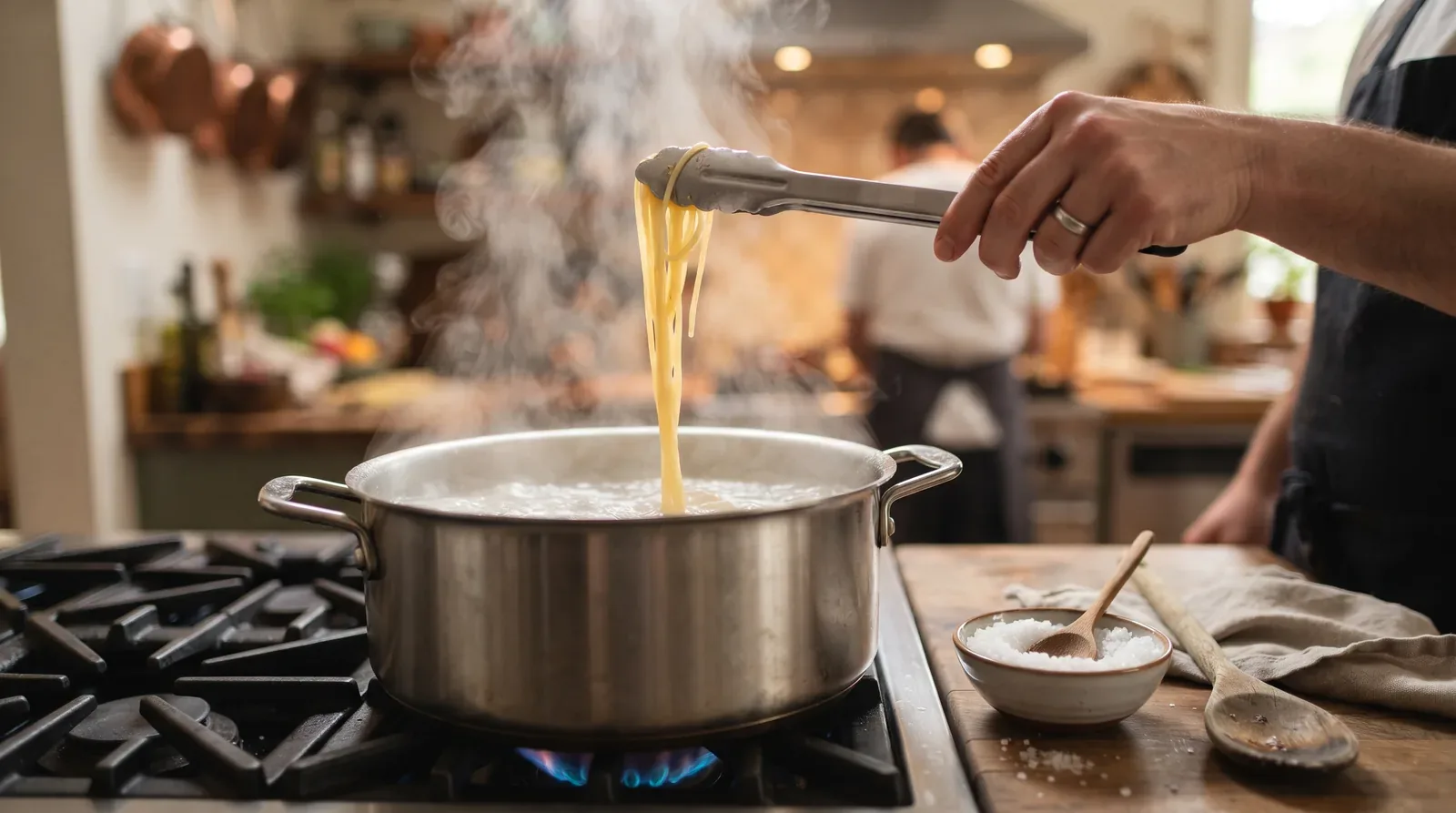
In this guide
Al dente is Italian for “to the tooth.” It describes pasta that is cooked through but still has a gentle bite at the center. It should not be crunchy, and it should not be soft and limp. When you get it right, pasta tastes better, holds sauce better and keeps its shape on the plate.
The good news is that al dente is not luck. It comes from a few simple habits: enough water, the right amount of salt, stirring early, tasting early and finishing the pasta in its sauce. This guide walks through each one, with exact amounts and timing.
You will find the method in six steps, a salt guide, timing by shape, how to test doneness, finishing techniques, special cases and the most common mistakes. The basic recipe at the end makes four servings of perfect al dente spaghetti.
| Question | Short answer |
|---|---|
| How much water? | About 4 quarts (3.8 liters) per pound of pasta. Less works if you stir well. |
| How much salt? | About 12 g per 4 quarts: roughly 1 1/2 tablespoons Diamond Crystal or 2 teaspoons fine sea salt. |
| When to start tasting? | 2 to 3 minutes before the low end of the package time. |
| How to tell? | Tender outside, slight firmness inside, a tiny pale dot in the center when cut. |
| Finishing in sauce? | Drain 1 to 2 minutes early and finish cooking in the pan with pasta water. |
What Al Dente Really Means
Dried pasta is made from durum wheat semolina and water. As it cooks, water moves from the outside in, and the starch swells and softens. Al dente pasta stops just before the very center is fully soft. That last bit of firmness gives the pleasant chew Italians look for.
Al dente vs undercooked
Undercooked pasta feels chalky or hard and has a thick white core. Al dente pasta feels tender when you bite, then gives a small, springy resistance in the middle. If the center tastes raw or floury, it needs another minute.
Al dente vs overcooked
Overcooked pasta is soft all the way through. It feels slippery, swells up and breaks easily. It also absorbs sauce poorly, because the outside is already saturated with water. Once pasta goes past al dente, there is no way back.
Why it matters for sauce
Pasta cooked to al dente still has room to absorb a little liquid. When you toss it in a pan sauce, it soaks up flavor and releases starch that thickens the sauce. That is why restaurant pasta tastes so well married to its sauce.
How to Cook Pasta Al Dente Step by Step
These steps work for any dried pasta, long or short. The only number that changes is the timing.
- 01
Step 1: Use plenty of water
Bring about 4 quarts (3.8 liters) of water to a full boil for each pound of pasta. Plenty of water returns to a boil quickly after the pasta goes in and gives the pasta room to move. You can use less water for short shapes if you stir often.
- 02
Step 2: Salt the water well
Once the water boils, add the salt. About 12 g per 4 quarts seasons the pasta from within without making it taste salty. That is roughly 1 1/2 tablespoons of Diamond Crystal kosher salt or 2 teaspoons of fine sea salt.
- 03
Step 3: Stir in the first two minutes
Add the pasta and stir right away, then keep stirring for the first 1 to 2 minutes. This is when the surface starch is sticky and strands glue together. After that, a stir every few minutes is enough.
- 04
Step 4: Taste early and often
Start tasting 2 to 3 minutes before the low end of the package time. Fish out a piece, let it cool for a few seconds and bite it. Taste every 30 to 60 seconds after that.
- 05
Step 5: Save the pasta water
Before you drain, scoop out a mug of the cooking water. It is full of starch and salt, and it is the secret to glossy sauces. Then drain the pasta quickly.
- 06
Step 6: Finish in the sauce
If the pasta is going into a sauce, drain it 1 to 2 minutes before it reaches al dente. Toss it in the pan with the sauce and a splash of pasta water over medium heat until it is perfect.

How Much Salt to Put in Pasta Water
Salt is the step most home cooks get wrong. Pasta absorbs water as it cooks, and the salt goes in with it. If the water is bland, the pasta stays bland, and no amount of salt in the sauce fixes it later.
The amount that works
Aim for about 12 g of salt per 4 quarts of water. That is roughly 0.3 percent salt by weight. The water should taste pleasantly seasoned, like a light broth. It should not taste like the sea, which is far saltier.
| Salt type | Amount for about 12 g |
|---|---|
| Diamond Crystal kosher salt | About 1 1/2 tablespoons |
| Morton kosher salt | About 2 1/2 teaspoons |
| Fine sea salt or table salt | About 2 teaspoons |
Why salt types differ
Salt crystals come in different shapes and sizes. Diamond Crystal flakes are light and hollow, so a spoonful weighs much less than the same spoon of fine salt. If you switch brands, measure by weight or adjust the spoon amount.
When to add salt
Add salt once the water boils. Salt added to cold water does no harm, but it can pit some stainless steel pots over time. Salt does not make water boil noticeably faster, and the amount you use barely changes the boiling point.
Adjusting for salty sauces
If your sauce is very salty, such as one with pecorino, capers, anchovies or cured pork, use a little less salt in the water. Carbonara is a good example. Our pasta carbonara uses slightly less salt in the pot for this reason.
Timing by Pasta Shape
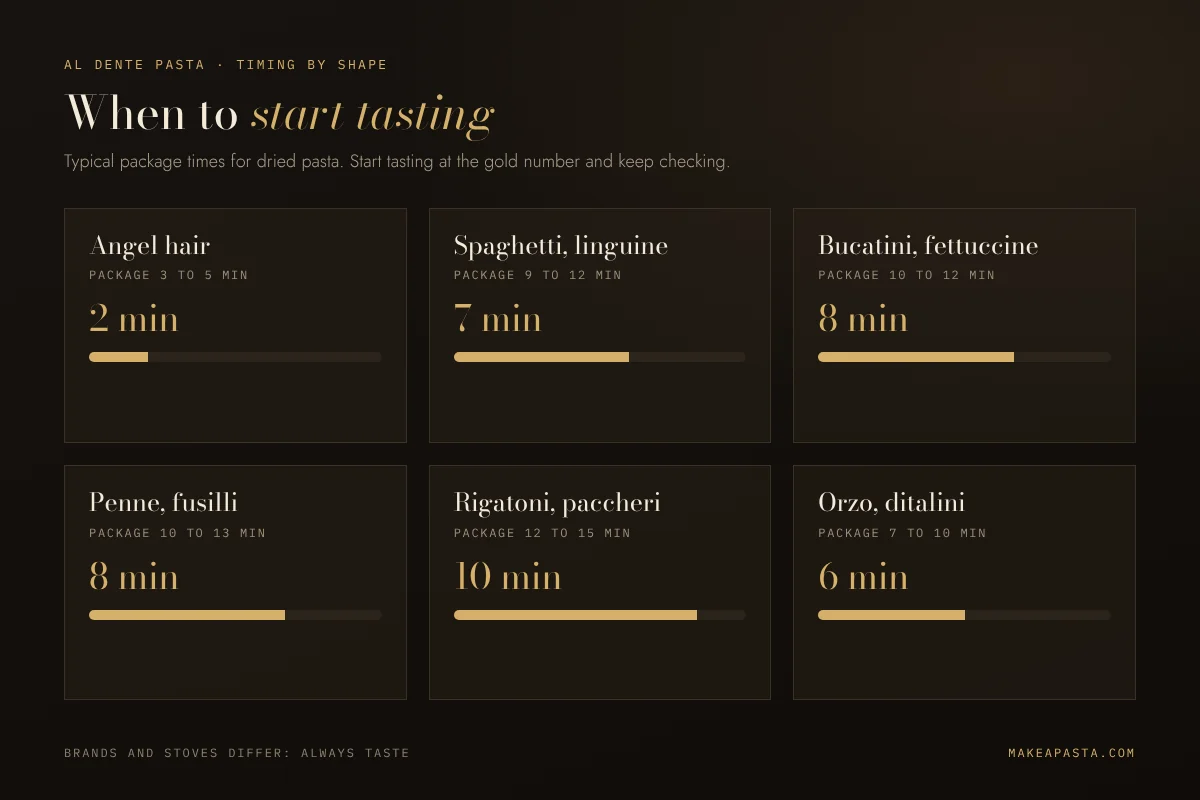
Package times are a good starting point, but they are not exact. Pots, stoves and brands all differ. Use the times below to know when to start tasting.
| Shape | Usual package time | Start tasting at |
|---|---|---|
| Angel hair, capellini | 3 to 5 minutes | 2 minutes |
| Spaghetti, linguine | 9 to 12 minutes | 7 minutes |
| Bucatini, fettuccine (dried) | 10 to 12 minutes | 8 minutes |
| Penne, fusilli | 10 to 13 minutes | 8 minutes |
| Rigatoni, paccheri | 12 to 15 minutes | 10 minutes |
| Orzo, ditalini | 7 to 10 minutes | 6 minutes |
Bronze-cut vs smooth pasta
Bronze-cut pasta is pushed through bronze dies that leave a rough, chalky surface. It often takes a minute or two longer and holds sauce very well. Smooth, Teflon-cut pasta cooks a little faster and looks shinier. Both can be perfectly al dente.
Small and thin shapes
Thin and small shapes go from al dente to soft in less than a minute. Watch them closely, and drain them as soon as they are ready. For the small rice-shaped pasta, our guide on how to cook orzo covers three ways to keep it firm.
How to Test for Al Dente
There are three good tests. Use the bite test every time, and the cut test when you are unsure.
The bite test
Take one piece out of the pot and let it cool for a few seconds. Bite through it. Al dente pasta feels tender at first, then gives a small, firm spring in the center. It should not crunch, and it should not taste of raw flour.
The cut test
Cut a strand or tube in half and look at the cross-section. Al dente pasta shows a tiny pale dot or thin pale ring at the center. A wide white core means it needs more time. No dot at all means it is fully cooked, which is right for soft pasta but past al dente.
Why the wall test is a myth
Throwing spaghetti at the wall only shows that the surface is sticky. Pasta sticks well before it is al dente and keeps sticking after it is overcooked. The bite test is faster, cleaner and far more accurate.

Finishing Pasta in the Sauce
The best pasta dishes are not just sauce poured over noodles. The two cook together for the last minute or two, which lets the pasta absorb flavor and thicken the sauce.
Drain early
Drain the pasta 1 to 2 minutes before it reaches al dente. It will keep cooking in the hot sauce, so it lands exactly right on the plate. This also means it never sits in a colander growing soft.
Use pasta water to bind the sauce
Add a splash of pasta water with the pasta and toss over medium heat. The starch helps oil, butter and cheese blend into a creamy sauce that clings. Add more water a tablespoon at a time if the sauce looks tight.
Do not rinse hot pasta
Rinsing washes away the surface starch that helps sauce stick. Only rinse pasta for cold dishes like pasta salad, where you want to stop the cooking and avoid gumminess.
Special Cases
Not all pasta behaves like dried wheat pasta. These need a slightly different approach.
Fresh egg pasta
Fresh pasta cooks in 1 1/2 to 4 minutes, depending on thickness. It does not have the firm center that dried pasta has. It is ready when it is tender, with no raw taste. Filled pasta, like our homemade ravioli, is done when the edges are tender.
Gluten-free pasta
Gluten-free pasta made from rice, corn or legumes softens quickly once it is done. Start tasting 3 to 4 minutes early and stir often, because it sticks more. Drain it as soon as it is ready and sauce it right away.
High altitude
At high altitude, water boils at a lower temperature. Pasta takes longer, often a few extra minutes. Keep the pot covered between stirs to hold the boil, and rely on tasting rather than the clock.
Microwave and one-pot pasta
These methods use less water, so the timing changes and the starch stays in the pot. Our microwave pasta guide lists water ratios and times for common shapes.
Common Mistakes to Avoid
| Mistake | What happens | Fix |
|---|---|---|
| Too little water | Water stops boiling and pasta sticks | Use about 4 quarts per pound, or stir constantly |
| No salt | Bland pasta that sauce cannot fix | Add about 12 g of salt per 4 quarts |
| Oil in the water | Slippery pasta that sheds sauce | Skip the oil and stir in the first two minutes |
| Trusting the box | Overcooked pasta | Taste 2 to 3 minutes before the package time |
| Draining all the water | Dry, tight sauce | Save a mug of pasta water every time |
| Letting it sit | Pasta keeps softening | Sauce and serve right after draining |
Storing cooked pasta
Toss leftover plain pasta with a little olive oil, cool it quickly and store it covered in the fridge. Eat it within 3 to 5 days, which matches the FoodSafety.gov cold storage chart for cooked pasta. Reheat it in sauce or dip it in boiling water for 30 seconds.
Al Dente Pasta FAQs
What does al dente mean?
Al dente means “to the tooth” in Italian. It describes pasta that is cooked through but still has a slight firmness in the center when you bite it. It should not be crunchy or taste of raw flour.
How do I know when pasta is al dente?
Start tasting 2 to 3 minutes before the package time. Al dente pasta is tender outside with a small, firm spring in the middle. If you cut a piece, you will see a tiny pale dot or thin ring at the center.
How much salt should I add to pasta water?
Use about 12 g of salt for every 4 quarts of water. That is roughly 1 1/2 tablespoons of Diamond Crystal kosher salt, 2 1/2 teaspoons of Morton kosher salt or 2 teaspoons of fine sea salt.
Should I add oil to pasta water?
No. Oil floats on top and does little to stop sticking. It can also coat the pasta so the sauce slides off. Stirring well in the first two minutes prevents sticking much better.
Should I rinse pasta after cooking?
Do not rinse pasta for hot dishes, because the surface starch helps the sauce cling. Rinse only for cold pasta salads, where you want to stop the cooking quickly and remove starch.
Is al dente pasta healthier?
Pasta cooked al dente is digested a little more slowly than very soft pasta, so it tends to have a lower glycemic index. The calories and nutrients are about the same. Most people choose al dente for its better texture.
Can fresh pasta be al dente?
Fresh egg pasta does not have the firm center of dried pasta. It cooks in 1 1/2 to 4 minutes and is ready when tender with no raw taste. Drain it promptly so it does not turn soft.
Final Thoughts
The rule to remember
Al dente pasta comes from paying attention, not from the box. Use plenty of well-salted water, stir early, start tasting a few minutes before the package time and trust the bite and the tiny pale dot in the center. Save a mug of pasta water, drain a minute early and finish the pasta in its sauce. Do that each time, and every pasta dish you make will taste better.
The recipe
Perfect Al Dente Spaghetti
A basic method for perfectly al dente spaghetti for four, finished with olive oil, black pepper and Parmesan. Use the same timing rules for any dried pasta.
Ingredients
Instructions
- Bring 4 quarts of water to a full rolling boil in a large pot over high heat. Cover the pot to bring it to a boil faster.
- Add the salt and let the water return to a boil. Taste a drop on a spoon once it cools; it should taste pleasantly seasoned, like a light broth.
- Add the spaghetti. Stir well for the first 1 to 2 minutes so the strands do not stick together, then stir every few minutes. Keep the water at a lively boil.
- Start tasting 3 minutes before the package time. Bite a strand: it should be tender outside with a slight firmness in the center. Look at a cut strand; a tiny pale dot in the middle means it is al dente.
- Before draining, scoop out 1 cup of pasta water. Drain the spaghetti when it is still 1 minute short of perfect if you plan to finish it in a sauce.
- Return the spaghetti to the warm pot with the olive oil, pepper and 1/4 cup of pasta water. Toss over low heat for 30 to 60 seconds, then add the Parmesan and toss until glossy. Add more pasta water as needed and serve right away.
Notes
Fresh egg pasta cooks in 1 1/2 to 4 minutes and is ready when tender with no raw floury taste; it does not have the firm center of dried pasta. Gluten-free pasta goes from firm to soft quickly, so start tasting 4 minutes early. At high altitude, water boils at a lower temperature, so pasta takes a few minutes longer. Do not add oil to the water and do not rinse pasta for hot dishes. Cooked pasta keeps 3 to 5 days in the fridge. Nutrition is approximate: about 555 calories, 15 g fat, 85 g carbohydrates, 4 g fiber and 19 g protein per serving.